


Yes, but it is almost always fixable. Audibility comes down to motor pitch, whether the toy touches a hard surface, and how the room carries sound, not how “loud” the toy claims to be. Closing the door and blocking the gap underneath, pressing the toy against your body or under a duvet, and running steady background noise resolves most of it within minutes.
TL;DR:
- Soundproofing measures like closing the door with a towel and moving the bed away from shared walls can significantly reduce noise transmission.
- Pressing the toy against the body or covering it with fabric absorbs vibration at the source more effectively than external muffling.
- Using steady background noise such as a fan or white noise app is more effective than intermittent sounds to mask residual noise.
- The surfaces and furniture the toy contacts, especially hollow or resonant objects, play a larger role in noise travel than the motor’s claimed loudness.
- Regular sound checks from outside the room confirm whether room adjustments effectively decrease audible sound levels.
Table of Contents
- Fixing vibrator noise through walls: what actually works
- Fast checklist: eight steps to run through right now
- Why room layout and furniture change how vibration travels
- Step-by-step muffling methods that actually work
- Using masking sound and timing to your advantage
- Testing your fixes and what to try if noise persists
- What Playhause looks for in a genuinely quiet toy
- Legal and privacy considerations you should actually know
- Advanced soundproofing when room-level tactics aren’t enough
- Where the usual advice on this misses the point
- Finding discreet, quieter toys on Playhause
- Sources
- FAQ
Fixing vibrator noise through walls: what actually works
The fastest way to know whether you have a problem is to test it, not guess at it. Run the toy on its highest setting, leave the room, and listen from the hallway, the kitchen, or wherever a housemate is likely to be. This single step, recommended by sex-toy researcher Amie Dawson, tells you more than any product description ever will, because the same toy can be silent in one bedroom and obvious in another depending on the walls, the floor, and what it’s resting against.
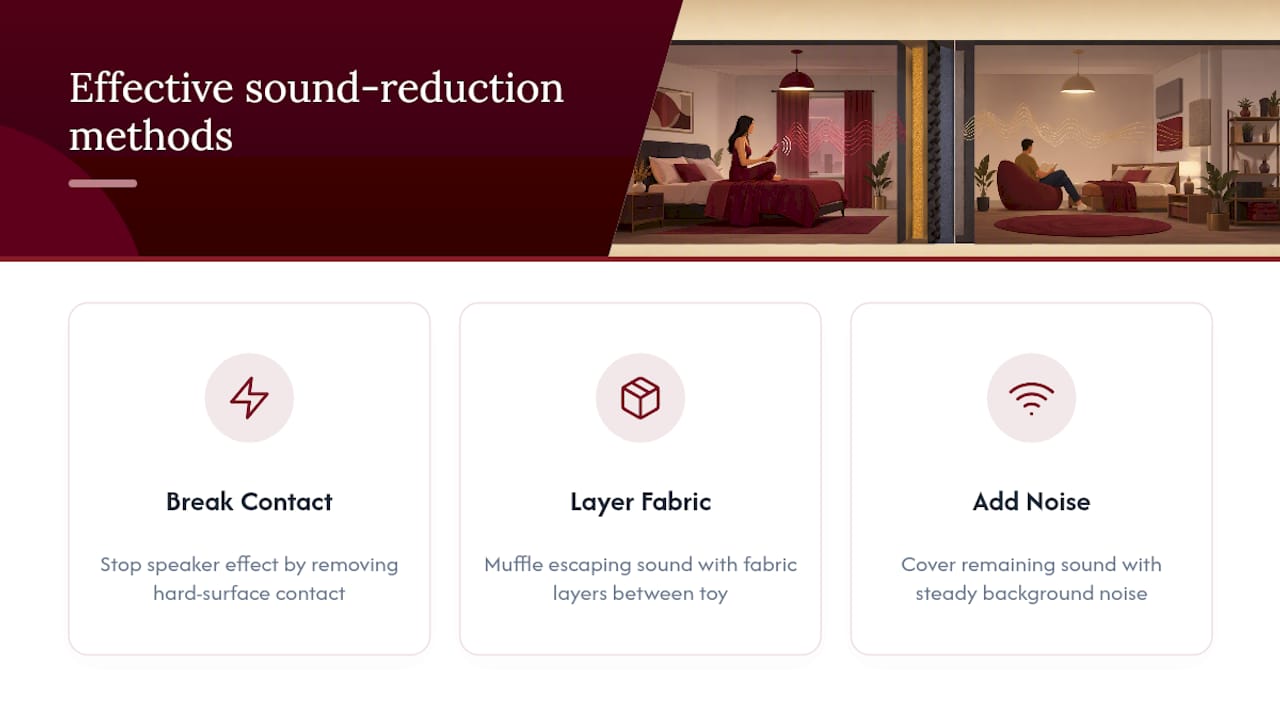
Once you know what you’re dealing with, three changes make the biggest difference. Breaking contact with hard surfaces stops the “speaker effect” that turns a quiet motor into a rattling one. Layering fabric between the toy and the air muffles the sound that does escape. Steady background noise covers whatever’s left. None of this requires new furniture or an evening with a toolbox, and you’ll usually know within a minute or two of testing whether you’ve solved it.
Fast checklist: eight steps to run through right now
Work through these in order. Most people stop needing the list after step four or five.
- Sound-check first. Set the toy to its highest setting and listen from outside the room, ideally from where a housemate would actually be.
- Shut the door properly. Push a towel into the gap underneath. Hollow-core doors leak sound far more than solid ones.
- Move the bed if you can. Even a few inches away from a shared wall reduces what travels through it.
- Lie face down or press the toy against your body. Skin and mattress absorb far more vibration than open air.
- Wrap the toy in a folded towel or tuck it under the duvet rather than leaving it exposed on top of the bedding.
- Avoid the headboard. If it touches the wall, it can carry vibration directly into the next room.
- Start a fan or a white-noise app before you begin, not after you’ve heard a knock on the door.
- Keep the toy off wood, glass, or bedside tables at any point during use, even briefly.
Why room layout and furniture change how vibration travels
Vibration doesn’t only travel through air. It travels through anything rigid that’s touching the toy, and that’s usually the part people overlook. A slatted bed frame, a hollow headboard, or a chipboard bedside drawer can pick up motor vibration and transmit it into the wall far more efficiently than the air ever would, which is why a toy that sounds moderate in your hand can seem much louder once it’s resting against furniture.
Distance still matters, and the physics behind it is straightforward. Sound is measured on a logarithmic scale, and in open air, the level drops by roughly 6 decibels each time you double the distance from the source. Moving your bed even a foot further from a shared wall, or simply closing an internal door, does more than most people expect for very little effort.
Practical fixes that follow from this:
- Add a rug or thick mat under the bed frame if it sits on bare floorboards.
- Slide a folded towel or foam pad under frame legs that touch the wall.
- Never rest the toy directly on wood, glass, or a hollow drawer front.
- If the headboard touches the wall, pull the bed forward even slightly.
Hollow, resonant furniture acts like an amplifier, so isolating contact points usually beats piling soft layers on top of a surface that’s still vibrating underneath.
Step-by-step muffling methods that actually work
Fabric and body contact do most of the heavy lifting here, and they cost nothing. Layering a duvet, a weighted blanket, or a quilt over both the toy and your body absorbs a surprising amount of motor noise before it ever reaches the air. If the toy has a firm base or edge that could tap against the mattress frame, slide a folded towel underneath it first; that small barrier stops contact noise before it starts.
Body-contact technique matters just as much as fabric. Lying face down with the toy pressed between your body and the mattress, or grinding against a pillow with the toy held in place, captures vibration in soft tissue and bedding rather than letting it radiate outward. This is the single most effective adjustment most people can make, because it addresses the noise at its source rather than trying to block it afterwards.
If you need to set the toy down mid-session, place it on a folded towel or a soft pad rather than a nightstand, drawer front, or anything hollow. Estimates suggest layering fabric and maintaining body contact can cut perceived motor noise by roughly 5 to 10 decibels, often enough to make a moderate toy genuinely hard to hear from an adjacent room.
- Duvet or weighted blanket over both toy and body
- Folded towel under the toy if it touches the mattress or frame
- Face-down or pillow-pressed positioning to absorb vibration directly
- Soft pad or towel under the toy any time it’s set down, never bare wood or metal
A shower can work as a masking option too, since running water creates steady white noise, but only with a toy explicitly rated for wet or submersible use, and only with sensible care around slipping on a wet surface.
Pro Tip: Test your muffling setup once with the toy off, just running your hand along the mattress and headboard. If you can feel a rattle or a knock through the frame, that’s the contact point to fix first, before you even think about fabric layers.
Using masking sound and timing to your advantage
Consistency beats volume when it comes to masking. A steady fan or white-noise machine blends with a vibrator’s hum far more effectively than intermittent loud music, because a sudden burst of sound followed by silence draws more attention than a constant background hum ever would. Placing that white-noise source near the door is particularly effective, since it’s usually the first sound anyone outside the room will actually hear.
A shower offers similar masking, though it comes with trade-offs. Running water covers sound well, but it also means someone has to notice you’re in there for a while, so staggering your entry and exit from the bathroom avoids drawing attention to comings and goings.
- Run a fan or white-noise app for the duration, not just at the loudest moments
- Position the noise source near the door rather than the far side of the room
- Choose times when the household is already noisy, like during a washing machine cycle or a TV programme
- Avoid completely silent, late-night hours if privacy is the priority
Testing your fixes and what to try if noise persists
Repeat the same test you started with. Set the toy to its highest setting, leave the room, and listen from the hallway, the kitchen, and any adjacent bedroom, since each space carries sound differently depending on wall material and furniture placement.
- If it’s still audible from the hallway, check for contact points first. A towel under the toy or frame often fixes what fabric layering alone can’t.
- If the noise is still there, drop to a lower intensity setting rather than the highest one; most toys are considerably quieter one or two levels down.
- Consider switching to an external-only design if internal designs keep proving too buzzy for your walls.
- If none of this works and the walls themselves seem unusually thin, that’s a structural issue rather than a technique problem, and it may be worth looking at proper soundproofing rather than continuing to adjust room-level tactics.
What Playhause looks for in a genuinely quiet toy
Playhause curates its range with discreet packaging and privacy in mind, but the toy itself still does most of the work when it comes to noise. A few category-level signals are worth checking before you buy, regardless of which retailer you use.
- Look for descriptions mentioning “rumbly” or brushless motors, since lower-frequency vibration tends to travel through walls less than high-pitched buzzing.
- Favour soft silicone bodies over rigid plastic shells, which resonate more against skin and bedding.
- Consider an external-only or remote design if internal toys have consistently proven too loud in your space.
- Check the waterproof rating explicitly if you’re planning to use running water as a masking tool.
If you’re choosing your first toy with discretion in mind, a beginner-friendly guide to quieter designs is a useful starting point before you commit to a purchase.
Legal and privacy considerations you should actually know
Sound travelling through a shared wall isn’t a criminal matter in the vast majority of ordinary households, but it does sit inside broader rules around noise nuisance that vary by tenancy and local authority. If you rent, most tenancy agreements include general clauses about not disturbing neighbours or other occupants, phrased around “unreasonable noise” rather than anything specific to intimate activity. That’s a civil and contractual matter between tenant and landlord, not a criminal one, and it’s rarely enforced for occasional, moderate sound.
What matters more practically is privacy, not legality. You have no obligation to explain or justify sound coming from your own room, and a housemate raising it as a general noise concern is different from anyone having a right to know its source. Treat it the same way you’d treat any other bit of noise courtesy, like keeping music down late at night, rather than something requiring a defence.
If you live in student housing, a shared flat, or with family, the sensible approach is the same one that solves the acoustic problem: reduce what travels, mask what remains, and you rarely need to have the conversation at all. Where walls are thin enough that ordinary conversation carries clearly, that’s a construction issue affecting everyone’s privacy equally, not something specific to one type of sound.
Advanced soundproofing when room-level tactics aren’t enough
Most people never need to go beyond fabric, positioning, and masking sound. But if you’re in a particularly thin-walled flat, or if testing keeps showing the sound carrying no matter what you try, a few structural options exist beyond the immediate fixes already covered.
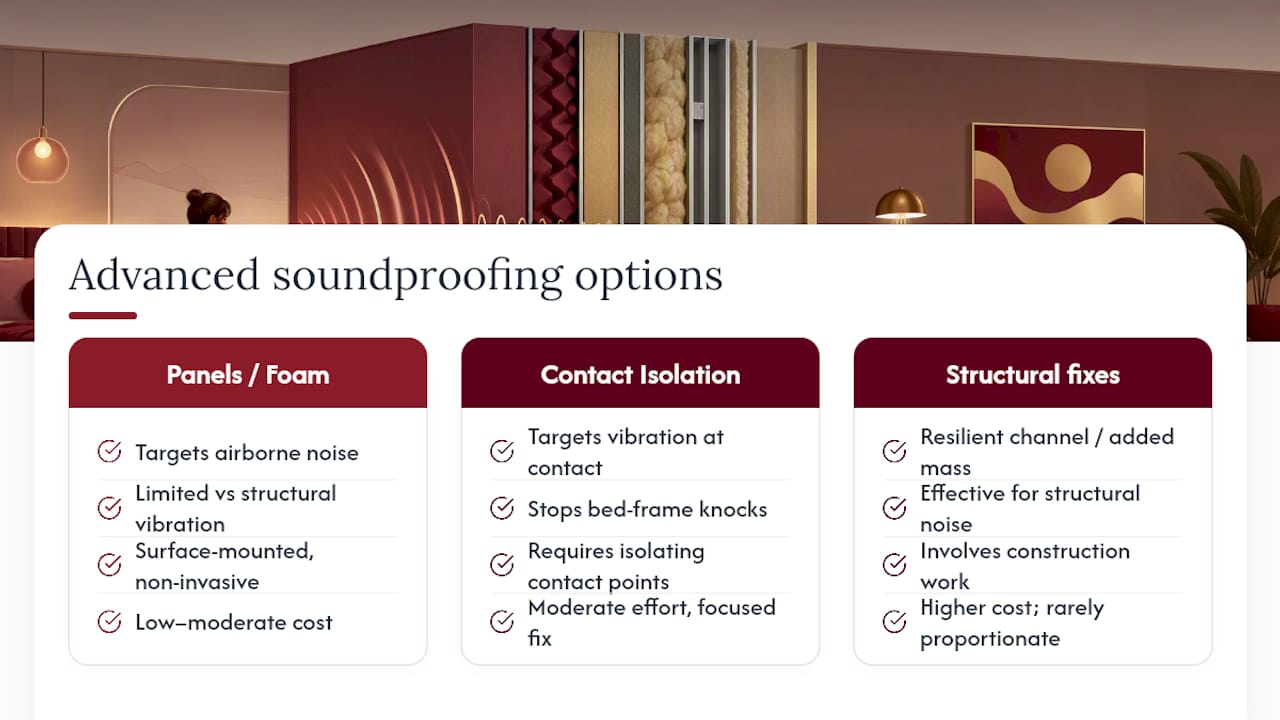
Acoustic panels fixed to the wall shared with a neighbour absorb sound within the room rather than letting it bounce and carry, though they work better against airborne noise than against vibration transmitted through the floor or frame. Soundproofing foam, similarly, reduces echo and some airborne transfer, but it won’t stop a bed frame physically knocking against a wall; that needs isolation at the contact point, not absorption at the surface.
For genuinely persistent structural noise, options like resilient channel mounting or added mass on a shared wall are effective but involve construction work, and they’re rarely proportionate for this specific issue. A cheaper middle step, often overlooked, is a solid door sweep and weatherstripping around the doorframe, since a surprising amount of “wall noise” is actually escaping through door gaps and travelling down a hallway rather than through masonry at all.
Before investing in any of this, run the sound check again after trying the room and fabric fixes covered earlier. Most readers find they never reach the point of needing panels or foam at all.
Where the usual advice on this misses the point
Most guides on this topic focus entirely on the toy: buy something labelled “whisper quiet” and the problem disappears. That’s backwards. The room does more work than the product ever will, and a toy with genuinely excellent reviews for quietness can still thump against a hollow bedside drawer and carry straight through a stud wall.
The advice that actually holds up under testing is the boring, mechanical stuff: break contact with anything hard, add mass and fabric where the vibration exits, and put steady sound at the door before you start, not after someone knocks. Motor choice matters at the margins, particularly rumbly versus buzzy designs, but it’s the fourth lever to pull, not the first.
If you take one thing from this, prioritise the sound check itself. Testing from outside the room, before and after each change, is the only way to know whether you’ve actually fixed anything or just assumed you have. Everything else follows from what that test tells you.
— Will
Finding discreet, quieter toys on Playhause
Playhause is built around exactly this concern: getting what you want without announcing it to the rest of the house. The site is organised so you can browse by category rather than wading through irrelevant listings.

If quiet performance matters most, start with designs built for external use or lower-intensity control, since these tend to give you finer control over intensity without the guesswork of an all-or-nothing internal motor. The guide to using toys together without awkwardness covers practical etiquette worth reading alongside the acoustic fixes above, and the couples’ toy range is a sensible next stop if you’re shopping for shared use rather than solo play. When you’re ready to browse the full range, head to the Playhause shop and filter by the features that matter to your situation, whether that’s waterproof rating, motor type, or external-only design.
Sources
- How loud are vibrators, really?
- How is sound measured? (NIDCD)
- How to muffle the sound of a vibrator when your walls are paper thin
- Shhhh: how to do it quietly when there are people nearby
FAQ
Why do I hear a vibrating sound in my wall?
A toy resting against or near a hard, hollow surface, like a headboard, bed frame, or bedside drawer, can transmit vibration into the structure of the room, which then carries into the shared wall. Breaking that contact with a towel or pad usually resolves it quickly.
How do I stop vibration noise from bothering neighbours or housemates?
Move the toy and bed away from shared walls, press the toy against your body or under a duvet rather than leaving it on furniture, and run steady background noise like a fan while you use it.
Can a quieter vibrator actually solve the problem on its own?
A lower-pitched, “rumbly” motor helps, but the surface it touches and the room’s acoustics usually matter more than the toy’s specifications alone.
Does running the shower actually mask the noise well?
Running water is an effective masking sound, but only pair it with a toy rated for wet use, and be mindful of slipping; staggering your entry and exit avoids drawing attention.
How can I test if my walls are actually thin enough to be a problem?
Set the toy to its highest setting, leave the room, and listen from the hallway, kitchen, and any adjacent room before and after making changes, so you know exactly which fixes are working.