


Choose organic cotton, TENCEL™ (lyocell), mulberry silk, or high-quality micromodal. These four fibres consistently score best for sensitive skin because they combine breathability, gentle surfaces, and low-chemical finishing. The guiding principle is simple: no single “natural” or “synthetic” label guarantees comfort. What matters is the weave, the finishing process, and how the seams meet your skin. Synthetics can still work, but only when they’re certified and used in well-ventilated designs.
TL;DR:
- Fabric weave, finishing, and seam type are crucial factors influencing lingerie comfort and irritation risk, beyond just the fiber used.
- Certified materials like GOTS organic cotton, OEKO-TEX®, and NPF Seal ensure lower chemical residues and less likelihood of skin reactions.
- TENCEL™ lyocell significantly reduces skin water loss compared to cotton, providing measurable skin barrier benefits for moisture-sensitive individuals.
- Silk and micromodal offer low friction and softness, but require careful handling and verified certification due to chemical processing concerns.
- Proper laundry routines, including washing new garments before wear and avoiding softeners, are essential to maintain skin-safe properties over time.
Table of Contents
- What are the best skin-safe lingerie materials?
- What makes a fabric skin-safe beyond the fibre itself?
- How do you choose lingerie for your specific sensitivity?
- How should you launder lingerie to keep it skin-safe?
- Why publisher and product-curation context matters here
- Are these hypoallergenic materials actually allergy-proof?
- Which materials suit eczema, psoriasis, and other reactive skin conditions?
- Skin safe lingerie materials: what the evidence actually supports
- Shop skin-safe lingerie with confidence at Playhause
- Sources
What are the best skin-safe lingerie materials?
Fibre choice sets the foundation, but it’s only half the story. You also need to know why each material behaves the way it does against skin that reacts easily to friction, moisture, or leftover manufacturing chemicals.
Organic cotton (GOTS certified) remains the benchmark for good reason. It’s grown and processed without the pesticides and synthetic fertilisers used in conventional cotton farming, and the certification also caps the chemical dyes and finishes applied afterwards. You’ll find it most useful in gussets, bralining, and anywhere fabric sits directly against genital or breast skin for extended periods. It breathes well, but a tightly woven cotton can still trap moisture, so weave density matters as much as the fibre itself.
TENCEL™ (lyocell) is where the science gets genuinely interesting. It’s made from wood pulp through a closed-loop process that recovers and reuses the solvents involved, which keeps chemical residue low compared with older cellulose fibres. Clinical comparisons have found TENCEL™ produces roughly 42% lower transepidermal water loss than conventional cotton, meaning it helps the skin barrier hold onto moisture rather than losing it to evaporation and friction. For anyone managing eczema-prone skin around elastic edges, that difference is measurable comfort, not marketing.
Mulberry silk offers the lowest friction of any common lingerie fibre. Its smooth filament structure glides rather than drags, which matters enormously for skin already irritated by chafing. The trade-off is care: silk demands cold hand-washing or a dedicated lingerie cycle, and it’s less forgiving of daily wear-and-tear than cotton or modal. It’s worth the effort for special-occasion pieces, less so for everyday basics.
Micromodal and modal split opinion because both derive from beech-tree cellulose using a viscose-style process. Done well, the result is a fibre that’s softer than cotton and wicks moisture faster; comparative industry testing shows quality micromodal can outperform synthetics on comfort and moisture control in close-contact garments. The caveat is that “modal” and “bamboo viscose” both travel through chemically intensive processing, so certification matters more here than with organic cotton.
Here’s how the main options compare:
- Organic cotton (GOTS): best for daily wear and gusset linings, breathable but check weave density.
- TENCEL™ lyocell: best for moisture-prone areas, lowest environmental processing footprint.
- Mulberry silk: best for reducing friction, requires careful hand-washing.
- Micromodal/modal: best for softness against skin, verify certification, given the viscose route.
- Certified microfibre or synthetic blends: acceptable only when OEKO-TEX® tested and used in ventilated, open-mesh construction.
Statistic callout: TENCEL™ lyocell has demonstrated around 42% lower transepidermal water loss than standard cotton in clinical skin-barrier comparisons, a meaningful figure for anyone whose skin reacts to prolonged moisture contact.
On elastane: a little goes a long way. Most lingerie needs elastane for shape retention, but sensitive-skin wearers do better with a lower proportion, particularly in gussets and underbands where the elastic sits closest to skin. Higher elastane content may improve shape recovery slightly but increases irritation risk faster than the benefit.
What makes a fabric skin-safe beyond the fibre itself?
Fibre choice gets most of the attention, but construction and finishing often determine irritation risk more than the raw material. A dense, tightly woven organic cotton can trap heat and moisture worse than an open synthetic mesh. That’s counterintuitive, but it’s exactly why “natural” isn’t a synonym for “safe.”
The real hidden triggers are usually invisible until they cause a reaction:
- Residual reactive dyes left over from incomplete rinsing during manufacture.
- Formaldehyde-based finishing resins used to reduce creasing.
- Adhesives holding trims, motifs, or labels in place instead of stitching.
- Softeners and plasticisers applied to synthetic elastics for a smoother hand-feel.
Seam and trim choices matter just as much. Covered elastics, flatlock or French seams, and cotton-lined gussets reduce friction points significantly compared with raw-edge or exposed elastic construction. Non-metallic hardware (nickel-free hooks and sliders) matters too, since nickel allergy is one of the more common contact triggers in intimate apparel.
Certifications translate these invisible risks into something checkable. GOTS requires at least 95% organic fibre content and restricts the dyes and chemicals used at every processing stage. OEKO-TEX® Standard 100 tests the finished textile for a defined list of harmful substances, regardless of fibre origin, which makes it a useful check even on synthetic blends. The NPF Seal (National Psoriasis Foundation) flags products independently assessed as unlikely to aggravate psoriasis or related skin conditions.
Pro Tip: If a new piece has a sharp chemical smell, a glued-on label, or an odour that lingers after unpacking, that’s usually unrinsed finishing residue talking. Wash it before it goes anywhere near your skin.
How do you choose lingerie for your specific sensitivity?
Getting this right isn’t guesswork if you follow a short, repeatable process before any new piece becomes part of your regular rotation.
- Patch test first. Cut a small swatch or use an inner seam, and hold it against the skin behind your ear or on your inner arm for 24 hours. This targets the same thin, reactive skin type found in most lingerie contact zones, so a clean result there is a genuinely useful predictor.
- Wash before wearing. New garments carry finishing residues from manufacturing, and a fragrance-free liquid wash strips most of it out before first contact. Two washes beat one if the piece still smells faintly chemical.
- Ask before you buy. Check the fibre percentage breakdown, not just the headline material; request the certification ID number rather than accepting a generic “eco-friendly” claim; confirm seam type and elastane percentage where the listing doesn’t state it clearly.
- Track your reactions. Note timing, location, and severity if something does flare up, across at least three wear cycles rather than one. A reaction on day one might be residue; a reaction that repeats each wear points to the fibre or trim itself.
- See a dermatologist when patterns persist. Recurring contact dermatitis in the same spot, regardless of brand, usually means it’s worth testing for a specific allergen like nickel or a textile dye class rather than continuing to guess.
How should you launder lingerie to keep it skin-safe?
Good fabric choices get undone fast by the wrong laundry routine, so the habits matter almost as much as the shopping.
Use a liquid detergent that’s fragrance-free and enzyme-free. Powder detergents and enzyme formulas are more likely to leave residue in delicate weaves, and fragrance is one of the most common contact irritants in textiles generally. Skip fabric softener entirely. It coats fibres with a waxy residue that reduces breathability, precisely the property you’re trying to preserve.
Wash on a gentle or delicate cycle in cool water, inside a mesh bag to protect seams and elastic from friction against zips and rougher fabrics. Air-dry rather than tumble-dry. Heat degrades elastane recovery faster than almost anything else, which shortens the working life of underbands and gussets. Rotate pieces rather than wearing the same items back to back, so elastic fibres get time to recover their shape between wears. When elastic stops springing back, that’s your cue to retire the piece rather than keep stretching it.
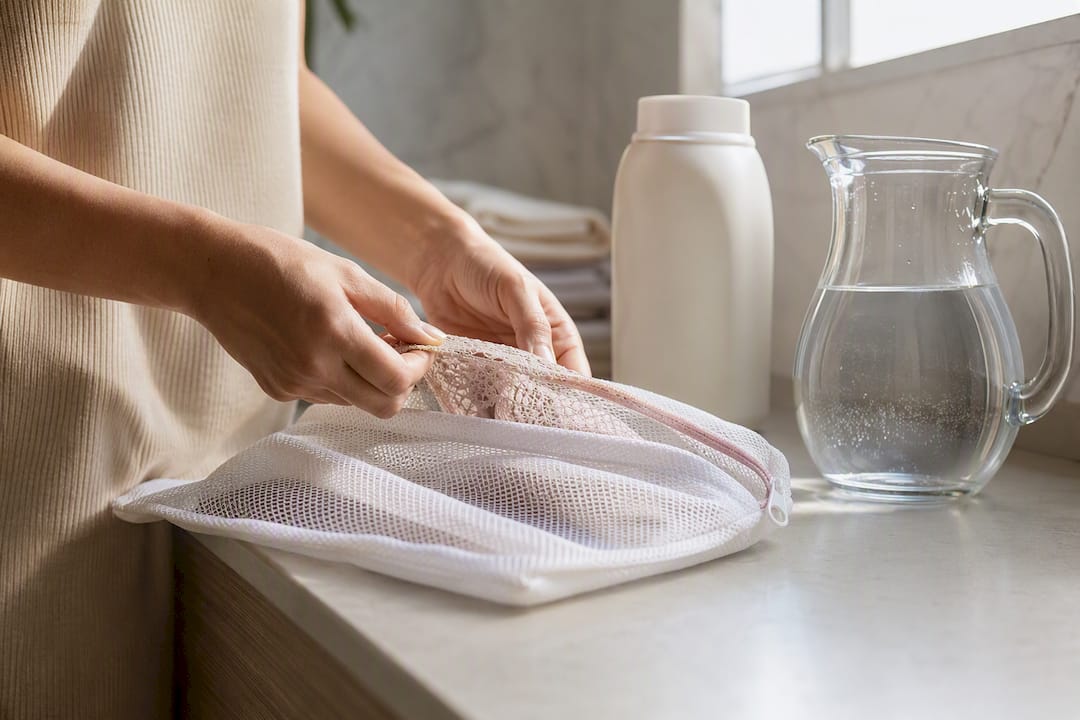
Pro Tip: For brand-new pieces with a noticeable “fresh from the factory” smell, run two cold washes with a gentle rinse cycle before the first wear. It’s the fastest way to clear residual finishing chemicals that a single wash might miss.
Why publisher and product-curation context matters here
This guide draws on dermatology-aligned textile research and industry fabric-testing sources rather than marketing copy, which is why construction gets equal billing with fibre choice throughout.
Playhause curates its lingerie ranges with an eye toward the materials and construction details covered in this guide, but curation isn’t a substitute for checking the specifics yourself. Every product page should list fibre percentages, and where a certification applies, the certifying body and, ideally, an ID number you can verify. Seam type and trim details are usually visible in product photography or the description, so look for covered elastics and flatlock stitching if you know friction is your particular trigger.
Treat product pages as a starting point for comparison, not as a substitute for lab certification. If a listing is vague on fibre content or construction, that’s worth asking about directly before you buy, not after a reaction.
Are these hypoallergenic materials actually allergy-proof?
No fabric is universally hypoallergenic, and that distinction trips people up more than any other part of this topic. “Hypoallergenic” means a material is less likely to trigger a reaction across a population, not that it’s guaranteed safe for every individual.
Organic cotton, TENCEL™, and mulberry silk earn their reputation because they lack the additives most commonly implicated in contact reactions: no residual pesticide traces, no heavy dye load, and in TENCEL™'s case, a manufacturing process that recovers its own solvents rather than leaving them in the finished fibre. That reduces the chemical trigger load substantially.
It does nothing, however, about mechanical triggers. A silk chemise can still cause irritation if a seam rubs the same spot for hours, and an organic cotton gusset can still trap moisture if the weave is too dense for the climate or activity. Genuine hypoallergenic performance depends on getting fibre, weave, and construction right together, not on ticking one box and assuming the rest follows. That’s the gap most buying guides skip past, and it’s the one that actually determines whether a “safe” fabric behaves safely on your skin.
Which materials suit eczema, psoriasis, and other reactive skin conditions?
Different conditions respond to different fabric properties, so a single “best material” recommendation oversimplifies more than it helps.
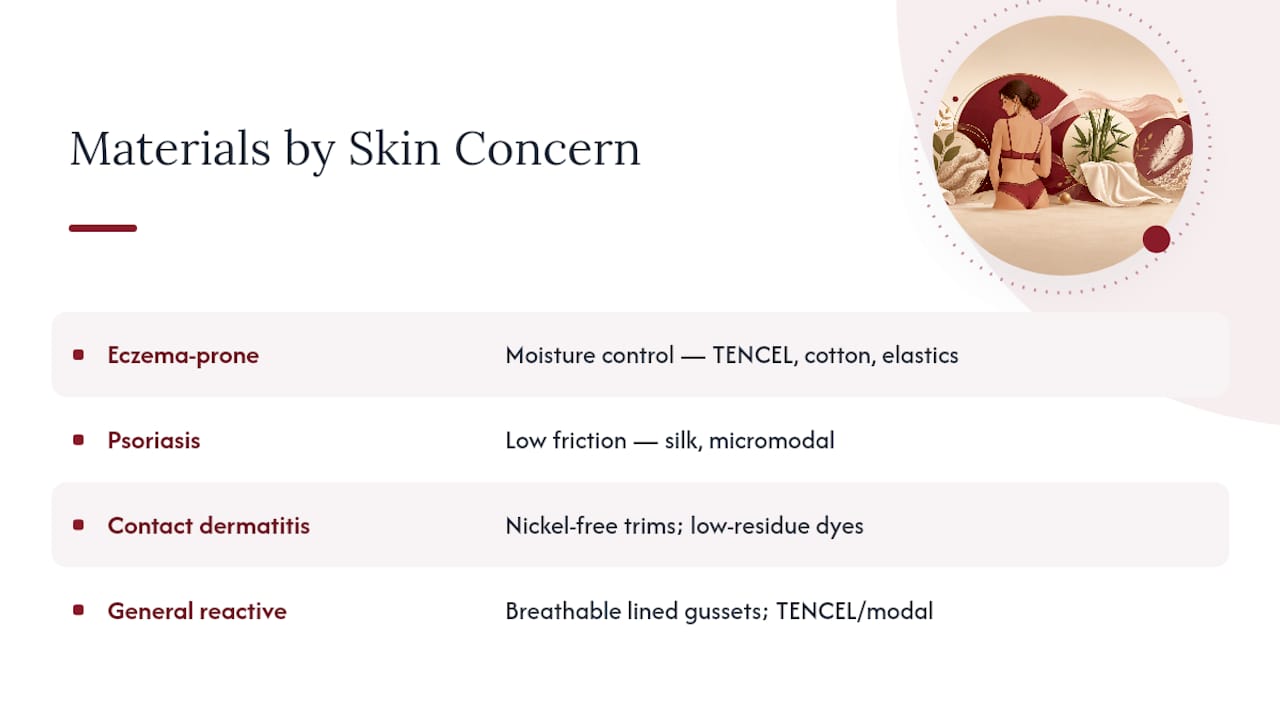
For eczema-prone skin, moisture management usually matters most, since flare-ups often follow prolonged dampness or friction on already-compromised skin barrier. TENCEL™'s wicking performance and cotton’s breathability both help here, and covered elastics reduce the friction that tends to trigger flares along underbands and leg openings.
For psoriasis, mechanical irritation is often the bigger concern, since scratching or rubbing scaled patches can worsen plaques. Smooth-surfaced fibres like mulberry silk and micromodal reduce that surface friction, and the NPF Seal specifically flags products assessed against this kind of aggravation risk.
For contact dermatitis or nickel allergy, the fibre matters less than the trims. Nickel-free hardware and certification confirming low-residue dyeing (GOTS or OEKO-TEX® Standard 100) address the actual trigger more directly than switching fabric alone would.
For general reactive or dry skin with no diagnosed condition, organic cotton lined gussets combined with TENCEL™ or modal panels offer the broadest safety margin, covering both moisture control and gentle surface contact without requiring silk’s higher-maintenance care routine.
Skin safe lingerie materials: what the evidence actually supports
The conventional advice on this topic stops at fibre names, and that’s where most guides fail readers. Telling someone to “buy organic cotton” without mentioning weave density or seam construction is a bit like recommending sunscreen without mentioning SPF. The material category is only ever half the equation.
What the research genuinely supports is a two-part filter: choose from the shortlist of low-chemical, breathable fibres, then interrogate the construction just as hard. A GOTS-certified cotton gusset with a raw, exposed seam can irritate more than a certified synthetic mesh with flatlock stitching and covered elastic. That’s not a comfortable conclusion for anyone hoping for a simple one-word answer, but it’s the honest one.
If you take one thing from this guide, prioritise certification transparency over fibre-name marketing. A listing that gives you a real GOTS or OEKO-TEX® ID number is telling you something checkable. A listing that just says “hypoallergenic” or “eco-friendly” with no backing detail is telling you nothing at all.
— Will
Shop skin-safe lingerie with confidence at Playhause
A curated route through criteria like those in this guide makes it easier to compare product pages without juggling a mental checklist. Browse ranges that lean on gentler construction, from chemises with softer linings to hold-ups designed with skin contact in mind, alongside discreet packaging and delivery options.

A few starting points worth checking against the guidance above: the Beauty Night BN6731 Lorna Red chemise, the Beauty Night BN6545 Eve Chemise Purple, and the Ballerina 572 Black/Emerald Stockings for hosiery with lower-friction trims. Always check the individual product page for fibre percentage, seam type, and any listed certification before buying, since specifications vary by style and season.
If a fibre breakdown or construction detail isn’t listed, Playhause’s customer care team can usually clarify it before you order. Start by browsing the full lingerie collection and filtering for the materials this guide recommends.
Sources
- Best fabric for sensitive skin | Healthline
- Choosing the right lingerie fabrics | Seamwork
- What makes lingerie allergy-friendly? A deep dive into materials and allergens | Juliemay