


A lingerie size chart UK is defined by two measurements: your underbust (band size) and your bust (cup size), both taken in inches. The band size is your underbust rounded to the nearest even number, and the cup size is the difference in inches between your bust and your band. Get these two numbers right, and the rest of the chart falls into place. This guide walks you through every step, from taking accurate measurements at home to reading the full UK size chart, understanding sister sizes, and adapting to brand differences. Whether you are shopping for everyday underwear or something more special, a correct fit starts here.
How to measure your bra size at home in the UK

Accurate measurement is the foundation of every good fit. Two numbers matter: your underbust and your bust, both measured in inches with a flexible tape measure.
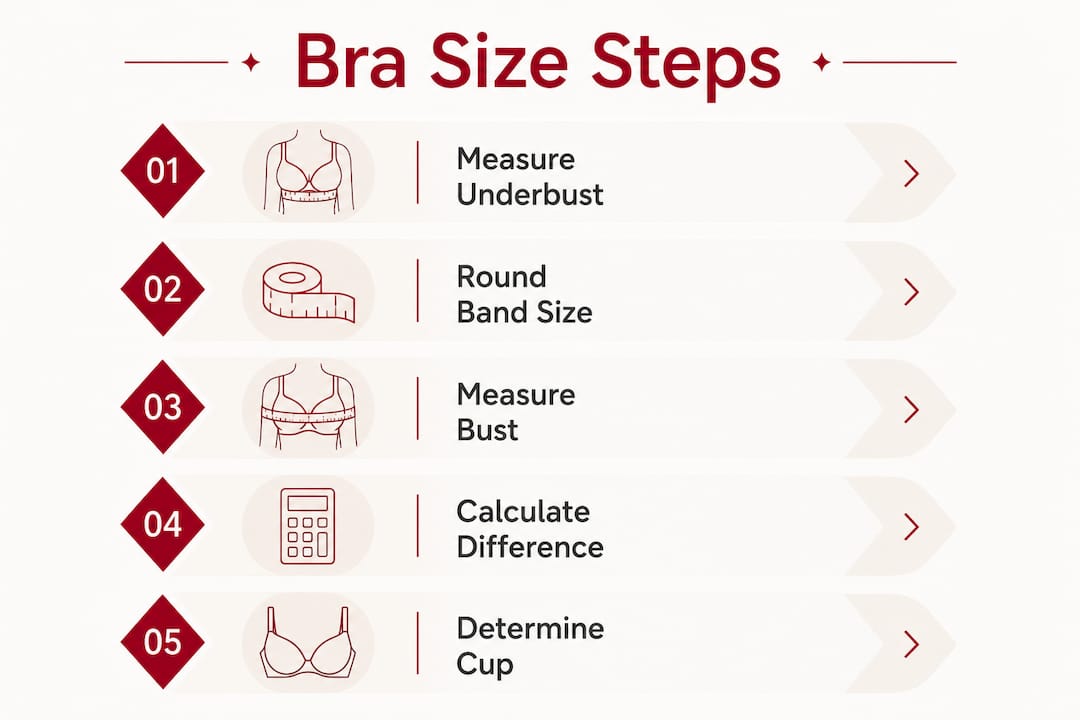
Follow these steps:
- Put on a non-padded, everyday bra. Measuring braless can underestimate tissue volume. A padded bra can overestimate it. A simple, unlined bra gives the most reliable baseline.
- Stand straight with your shoulders relaxed. Posture and relaxed breathing critically affect your result. Breathe out normally before you take each reading. Hunching or tensing your ribcage distorts the band measurement.
- Measure your underbust. Wrap the tape snugly around your ribcage, just below your bust. Note the number in inches.
- Round to the nearest even number. A 33-inch underbust becomes a 34 band. A 32-inch underbust stays at 32. This is your band size.
- Measure your bust. Wrap the tape around the fullest part of your bust, keeping it parallel to the floor. Do not pull it tight.
- Repeat both measurements. Take each reading twice and use the consistent result. Small errors compound when you calculate cup size.
Pro Tip: Always measure in inches rather than centimetres for UK sizing. Converting between units introduces rounding errors that can shift your cup size by a full letter.
What does the UK lingerie size chart actually mean?
The UK bra size chart combines your band number with a cup letter. The band is straightforward. The cup requires one extra calculation.
How cup size is calculated
Cup size is the difference in inches between your bust measurement and your band size. Each inch of difference equals one cup letter. A difference of 1 inch is an A cup, 2 inches is a B cup, 3 inches is a C cup, and so on. A difference of 4 inches gives you a D cup in UK sizing.
The UK cup sequence extends further than many people realise. After D, the letters continue: DD, E, F, FF, G, GG, H, HH, J, JJ, K. This matters because a woman who measures a 5-inch difference is not an E cup in the American sense. She is a DD in UK sizing. Mixing up these systems is one of the most common reasons people end up in the wrong size.
UK band and cup size reference table
| Underbust (inches) | Band size | Bust difference (inches) | Cup size |
|---|---|---|---|
| 27–28 | 28 | 1 | A |
| 29–30 | 30 | 2 | B |
| 31–32 | 32 | 3 | C |
| 33–34 | 34 | 4 | D |
| 35–36 | 36 | 5 | DD |
| 37–38 | 38 | 6 | E |
| 39–40 | 40 | 7 | F |
| 41–42 | 42 | 8 | FF |
This table gives you a working reference. Your band size comes from the left column. Your cup letter comes from the right. Combine them and you have your starting UK size.
Pro Tip: Ignore the old “+4 method” if you see it on older size guides. Modern fitting favours using your actual underbust measurement rounded to the nearest even number. The +4 method was designed for rigid, non-stretch fabrics and consistently produces an oversized band.
What are sister sizes and how do they improve fit?
Cup size is relative to band size, not absolute. A 34D and a 36D hold different volumes of fabric. This is the principle behind sister sizes, and it is one of the most useful tools in lingerie fitting.
What sister sizes are
Sister sizes are pairs of bra sizes that share the same cup volume but use different band sizes. Moving up one band size and down one cup letter keeps the cup volume constant. Moving down one band size and up one cup letter does the same. The cup shape stays the same. Only the band changes.
When to use them
- The band feels too tight but the cups fit well. Move to a 36C if you are currently in a 34D.
- The band feels too loose but the cups fit well. Move to a 32E if you are currently in a 34D.
- Your exact size is out of stock. A sister size gives you the same volume in a different band.
- You are between sizes and unsure which way to go. Try both sister sizes and compare comfort.
Sister size reference table
| Your current size | Tighter band option | Looser band option |
|---|---|---|
| 32D | 30E | 34C |
| 34D | 32E | 36C |
| 36D | 34E | 38C |
| 34DD | 32E | 36D |
| 36E | 34F | 38DD |
Moving from a 34D to a 36C keeps the cup volume identical while giving you a more comfortable band. This is the most practical application of sister sizing, and it works across the full UK size range.
Pro Tip: Sister sizes work best as a short-term fix or a fine-tuning tool. If you consistently need to go up two band sizes for comfort, your cup size calculation may need revisiting. Return to your measurements first.
How to handle size differences across UK lingerie brands
Size charts are starting points, not guarantees. Two bras labelled 34D can fit very differently depending on the brand, the fabric, and the construction method. This is not a flaw in the system. It is a natural result of how garments are made.
Rigid fabrics like structured satin give less stretch than soft lace or jersey. A 34 band in a rigid fabric will feel tighter than the same band in a stretch fabric. Materials like rigid fabrics versus stretch lace impact fit beyond what any size number can predict. The number tells you where to start. The fabric tells you how to adjust.
Here is how to adapt your approach across brands:
- Treat your measured size as a starting point. If a 34D feels off in one brand, try a 36C or 34DD before assuming the chart is wrong.
- Check each brand’s specific size guide. Many UK brands publish their own measurement charts, and the differences can be significant.
- Pay attention to the band first. A well-fitted band carries 80% of the bra’s support. If the band rides up at the back, go down a band size.
- Re-measure every 6–12 months. Physical changes like weight shifts or hormonal cycles affect your size. A size that fitted perfectly last year may not fit the same way now.
- Assess fit by feel, not by label. The cups should lie flat against your chest with no gaps or spillage. The underwire, if present, should sit against your ribcage, not on breast tissue.
For a broader look at how fit works across different lingerie styles, the Playhause lingerie fit guide covers practical advice on choosing pieces that suit your body and your measurements.
Key takeaways
Accurate UK lingerie sizing requires two measurements taken in inches, a clear understanding of the band and cup calculation, and a willingness to adjust based on fabric, brand, and body changes.
| Point | Details |
|---|---|
| Band size from underbust | Measure your underbust in inches and round to the nearest even number. |
| Cup size from difference | Subtract your band size from your bust measurement; each inch equals one cup letter. |
| Sister sizes preserve volume | Moving up one band and down one cup keeps the same cup volume for a better fit. |
| Brand variation is real | Fabric and construction mean the same size label fits differently across brands. |
| Re-measure regularly | Body changes affect size; re-measure every 6–12 months to stay accurate. |
Why the numbers matter less than you think
I have spent years helping people understand lingerie sizing, and the single most common mistake I see is treating the size chart as a fixed answer rather than a starting point. Someone measures a 34D, buys a 34D, and then assumes the bra is wrong when it does not fit. The chart gave them the right place to begin. The brand, the fabric, and the style took it somewhere else.
The +4 method still appears on older guides and in some high-street fitting rooms. It consistently produces an oversized band, which means the bra rides up and the cups gap. If you have ever been told you are a 36B and suspected something was off, this is probably why. Modern measurement, using your actual underbust rounded to the nearest even number, is more accurate and more comfortable.
Sister sizes changed how I think about fit entirely. The idea that a 34D and a 36C hold the same cup volume is not intuitive. Once you understand it, you stop hunting for one perfect number and start thinking about the relationship between band and cup. That shift makes shopping far less frustrating.
The most practical advice I can offer is this: measure accurately, start with the chart, try the sister sizes if the fit is close but not right, and re-measure when your body changes. Comfort is the goal. The label is just a tool to get you there.
— Will
Lingerie that fits: what Playhause offers
Finding your size is only half the process. The other half is finding pieces worth wearing.

Playhause carries a curated range of lingerie and hosiery designed with fit and quality in mind, including the Ballerina 800 Hold Up with Pheromones and the Ballerina 119 Hold Up Bianco, both available in UK sizes with clear sizing guidance. Every order over £60 includes free delivery, and all packaging is fully discreet. Whether you are buying for yourself or as a gift, Playhause makes it straightforward to shop with confidence. Browse the full lingerie and hosiery range and use your measurements to find the right fit from the start.
FAQ
What is the UK bra size chart based on?
The UK bra size chart uses two measurements: the underbust in inches for the band size, and the difference between bust and band in inches for the cup letter. Each inch of difference equals one cup size, starting at A.
How do I measure my bra size at home in the UK?
Wear a non-padded bra, measure your underbust snugly in inches and round to the nearest even number, then measure your bust at the fullest point. Subtract the band from the bust to find your cup letter.
What are sister sizes in UK bra sizing?
Sister sizes share the same cup volume with a different band size. Moving up one band and down one cup, or down one band and up one cup, keeps the cup volume constant while changing how the band fits.
Why does my size feel different across UK brands?
Fabric and construction cause fit to vary between brands. Rigid fabrics feel tighter than stretch lace at the same size. Always treat your measured size as a starting point and adjust based on how the garment actually feels.
How often should I re-measure for lingerie sizing?
Re-measure every 6–12 months, or sooner if you notice signs of poor fit such as a riding band or gaping cups. Body changes from weight shifts or hormonal cycles affect your measurements over time.