


Playhause is a solid starting point if you want a queer-affirming, body-safe shop without the guesswork: the range is curated, packaging is discreet, and the checkout is built around privacy. Browse the PlayHause storefront directly, or read on for the checklist that separates genuinely inclusive stores from shops that just say the right words.
TL;DR:
- Reputable stores clearly label toy materials with details like medical grade silicone or phthalate-free plastics, avoiding vague descriptions like “silicone blend.”
- Shopping for gender-affirming products requires precise measurements and size charts, not vague adjectives such as “one size fits most.”
- Online retailers with secure checkout, discreet packaging, and transparent returns policies provide safer, more private experiences, especially when local options are unavailable.
- Genuine inclusive shops are often run by queer owners, feature diverse imagery, and offer education through guides, classes, or trained staff, not just rainbow branding.
- Customer reviews with detailed feedback and responsive merchant replies are essential for assessing trustworthiness, particularly on platforms like Google Reviews.
Table of Contents
- What actually signals a genuinely LGBTQ+ friendly sex toy store
- Where do you actually find queer-owned and inclusive sex shops?
- What to check before you buy: safety, sizing, and privacy
- How do you shop safely online without a local option nearby?
- Why Playhause earns a place on this list
- Community engagement and events at queer-friendly stores
- Accessibility in LGBTQ+ friendly sex toy shopping
- How to read reviews and reputation for these stores
- What does it cost to shop at a queer-focused store?
- The editorial take: what actually matters when you’re shopping
- Ready to shop with Playhause?
- Sources
What actually signals a genuinely LGBTQ+ friendly sex toy store
Rainbow branding on a homepage tells you nothing. What tells you something is what happens once you start browsing or ask a question. A genuinely inclusive store shows its work in the details, not the marketing copy.
Start with who runs the place and how they talk about staff. Queer-owned businesses often say so plainly, and job listings or “meet the team” pages that mention pronouns and diverse hiring practices are a good early signal. That alone doesn’t guarantee good service, but its absence is worth noting.
Product range tells you more than any tagline. A store serious about gender-affirming shopping stocks packers, STPs (stand-to-pee devices), and harnesses in a genuine spread of sizes, not one generic strap-on buried on page four of a category filter. If binders or gaffs appear alongside vibrators and lubricant, that’s a retailer thinking about more than one kind of customer.
Look at the imagery too. Product photography and marketing that feature a range of body types, skin tones, and gender presentations, rather than a single narrow beauty standard, usually reflects who the store is actually building for. Boutiques like She Bop build their entire identity around this, pairing body-safe products with visible sex education content rather than treating inclusivity as decoration.
Education matters as much as stock. Shops that publish buying guides, run classes, or train staff to answer material and fit questions confidently tend to have thought harder about their customers than ones that simply list SKUs.
Finally, check the practical trust signals:
- Clear labelling of materials (medical-grade silicone, phthalate-free plastics, non-porous surfaces)
- A returns policy that’s honest about hygiene limits, not vague
- Discreet shipping and neutral billing described in plain language, not buried in small print
- Visible customer reviews, not just a star rating with no text behind it
Pro Tip: If a product page won’t tell you what material something is made from, treat that as a red flag, not a minor omission. Reputable sellers list it every time.
Where do you actually find queer-owned and inclusive sex shops?
Discovery is the hardest part, and most people default to a Google search that surfaces the same three national chains. A better approach mixes editorial research with community knowledge.
- Start with curated lists, but verify them. BuzzFeed’s roundup of 21 queer-owned and operated sex shops and The Knot’s own queer-owned sex toy shops feature are useful starting points, but ownership and policies change. Check the store’s current “about” page before you buy, not just the article that recommended it.
- Check local guides for brick-and-mortar options. City-specific write-ups, such as the Denver sex shop guide from Feral Fern Boudoir, can point you to inclusive shops near you, though a recent review often gives a more accurate picture than an older blog post.
- Ask your community directly. LGBTQ+ centres, mutual-aid networks, and Pride organisers frequently maintain informal lists of vetted local businesses that never make it onto search engines.
- Refine your search terms. Adding “queer-owned,” “gender-affirming,” or “body-safe” to a search does more filtering work than “LGBTQ sex toys” alone, which mostly returns generic category pages.
- Weigh online against in-person. Online stores tend to win on discretion, sizing guides, and education pages you can read at your own pace. In-person shops win on staff who can talk you through fit on the spot, if you can find one nearby that’s genuinely welcoming.
What to check before you buy: safety, sizing, and privacy
The checkout page is where good intentions either hold up or fall apart. A handful of checks here prevents most of the regret people report after a rushed purchase.
Material labelling comes first. Look for medical-grade silicone, ABS plastic, or borosilicate glass listed explicitly, alongside confirmation that the item is phthalate-free and non-porous. Non-porous materials don’t harbour bacteria the way jelly rubber or porous TPE can, which matters for anything used internally or shared between partners. If a listing just says “silicone blend” with no further detail, ask before you buy.
Sizing needs real numbers, not adjectives. For harnesses, packers, and STPs, a good product description gives measurements, waist ranges, and material flexibility rather than vague sizing like “one size fits most.” Gender-affirming products fail their purpose if the sizing chart was clearly written for a different category of item.
Privacy is a checkout-level decision, not a marketing claim. Look for confirmation of discreet outer packaging, a neutral billing descriptor on your card statement, and a secure checkout process. Playhause, for example, ships discreetly and offers free delivery on orders above a moderate purchase amount, which is the kind of detail worth confirming on any site before you enter payment information.
Returns and hygiene policies deserve a proper read. Many intimate items are non-returnable once opened, for straightforward hygiene reasons, and a trustworthy retailer says this clearly on the product page rather than leaving you to discover it after a complaint.
Consumer sentiment data on retailers, visible through platforms like Google’s merchant review system, gives you a real-time read on whether a shop delivers on its promises. A pattern of complaints about slow shipping or unclear billing is worth more than any homepage claim.
Finally, check for customer service that goes beyond a contact form:
- Live chat or product advisors who can answer fit and material questions before purchase
- An FAQ or education section that addresses gender-affirming products specifically, not just vibrators
- Staff who reference body-safety terminology accurately, which usually indicates real training rather than a script
Pro Tip: Email a specific sizing or material question before you buy anything gender-affirming. A quick, knowledgeable reply tells you more about a retailer than any about page ever will.
How do you shop safely online without a local option nearby?
Not everyone has a queer-friendly shop within driving distance, and that’s precisely where a well-run online retailer earns its keep. The safety checklist is short but non-negotiable.
- Read the privacy policy before you read the product descriptions. A retailer with nothing to hide states plainly how your data is stored and whether it’s shared with third parties.
- Check for verified reviews and a working contact channel, not just a phone number that goes nowhere.
- Confirm secure checkout (look for HTTPS and a recognised payment processor) and discreet billing before you enter card details.
- Know your recourse if something goes wrong. A legitimate seller has a clear process for refunds or exchanges on faulty items, distinct from its hygiene-based no-returns policy on opened products.
If distance or local options are limiting you, remote options can substitute for more than convenience. Remote-control toys let long-distance couples stay connected physically, and educational guides fill the gap a knowledgeable in-store assistant would otherwise cover. For anyone starting out together, a guide to using toys as a couple without the awkwardness does a lot of the reassurance work that a good shop assistant would do in person.
Why Playhause earns a place on this list
Playhause isn’t trying to be everything to everyone, and that’s the point. The curated range focuses on quality and fit rather than volume, with discreet packaging as standard and free delivery on orders over £60. Customer testimonials consistently highlight fast, quiet delivery, which matters more than most retailers admit when you’re ordering something intimate.
Beyond the storefront, Playhause’s own blog does real educational work. Guides covering safe toy storage and hygiene, remote-control play for couples, and lubricant selection reflect the kind of first-hand product knowledge a good retailer should have, not recycled marketing copy.
| What to look for | Where Playhause delivers |
|---|---|
| Discreet shipping | Standard on every order |
| Free delivery threshold | Orders over £60 |
| Educational content | Blog guides on storage, lube, and remote play |
| Product curation | Focused range over generic mass-stocking |
Start with the Playhause landing page if you want to browse the full range in one place.
Community engagement and events at queer-friendly stores
Inclusive doesn’t stop at the checkout for the best shops. Many queer-affirming retailers, particularly brick-and-mortar boutiques, treat their storefront as a community space as much as a shop floor.
Workshops on topics like anal play basics, rope bondage fundamentals, or gender-affirming product fitting are common at independent queer-owned shops, often run by staff or invited educators rather than sales reps pushing product. Some stores host support groups or discussion nights aimed at trans and non-binary customers navigating packing or binding for the first time, spaces where questions that feel awkward in a general store become completely normal.
Pride season tends to bring this into sharper focus. Queer-owned shops frequently sponsor local Pride events, staff booths, or donate proceeds from specific product lines during June, and some keep that community presence going year-round rather than treating it as a seasonal marketing moment.
None of this is essential to buying a single product safely. But if you’re choosing between two otherwise similar retailers, a track record of genuine community involvement, rather than a rainbow logo that appears for four weeks and disappears, tells you which one actually understands the customers it’s serving.
Accessibility in LGBTQ+ friendly sex toy shopping
Accessibility gets less attention in this conversation than it deserves. A store can be entirely queer-affirming in its product range and still be inaccessible to a meaningful share of its customers.
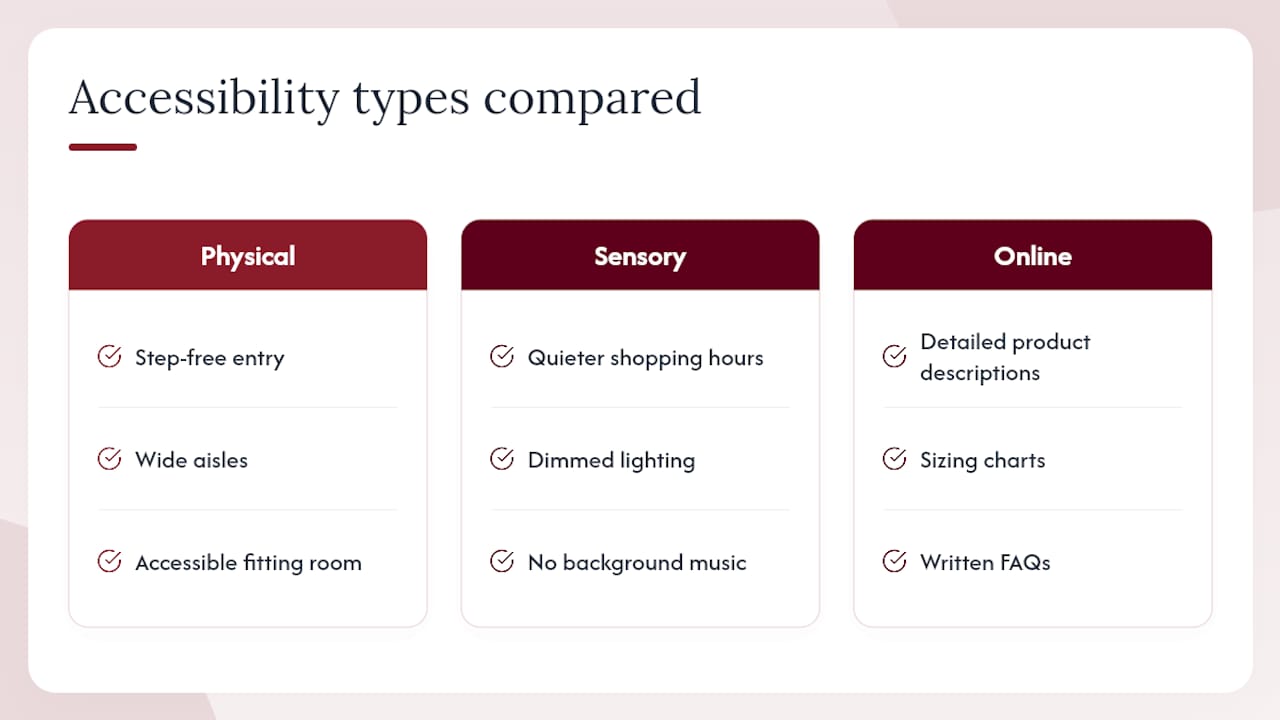
Physical accessibility matters for brick-and-mortar boutiques specifically: step-free entry, wide aisles for wheelchair users, and accessible changing or fitting areas for lingerie and harnesses aren’t universal even among inclusive shops, so it’s worth checking before a visit rather than assuming.
Sensory considerations matter just as much, particularly for neurodivergent shoppers. Some independent stores now offer quieter shopping hours with dimmed lighting and no background music, recognising that a bright, loud retail floor can make an already sensitive shopping trip harder than it needs to be.
Online shopping removes several of these barriers by default, which is part of why it’s become a genuine equaliser rather than just a fallback. Detailed product descriptions, sizing charts, and written FAQs let a shopper research thoroughly at their own pace, without navigating an unfamiliar physical space or a rushed conversation with staff. For anyone whose access needs make in-person shopping difficult, that’s not a consolation prize. It’s often the better option outright.
How to read reviews and reputation for these stores
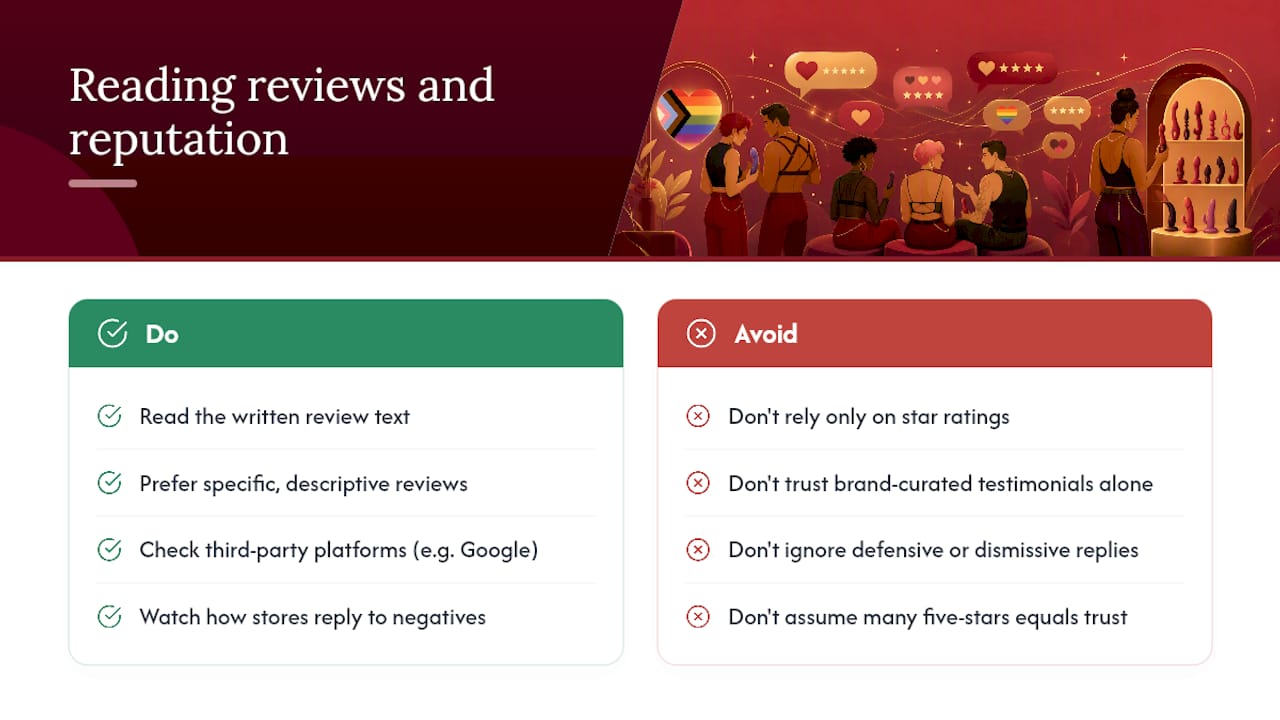
Reviews carry more weight in this category than almost any other retail sector, because discretion and trust are harder to verify upfront. You can’t test a product before buying it, so you’re relying entirely on what previous customers say about fit, material quality, and how the company handled problems.
Look past the star rating and read the actual text. A retailer with hundreds of five-star reviews but no written detail is less useful than one with a smaller number of specific, descriptive reviews mentioning sizing accuracy or how a return was handled. Merchant review platforms, including Google’s own review system, let you check this kind of detail directly rather than trusting curated testimonials on a brand’s own site.
Pay particular attention to how a store responds publicly to negative reviews. A defensive or dismissive reply to a legitimate complaint about sizing or shipping tells you more about that retailer’s culture than ten glowing five-star reviews ever will. Consistency matters too: a shop with steady, detailed positive feedback over years is a safer bet than one with a recent spike in reviews that reads suspiciously uniform.
Mainstream lifestyle coverage, the kind HuffPost and similar outlets run regularly on sex-positive retail, can also serve as a useful reputation check, since these features tend to vet the businesses they cover before publishing.
What does it cost to shop at a queer-focused store?
Price sits in an odd place in this category. Queer-owned boutiques are often smaller operations with tighter margins than the big mainstream chains, and that sometimes shows up as slightly higher prices on comparable items, particularly for niche gender-affirming products like packers and STPs that serve a smaller manufacturing market.
That’s not a reason to avoid them. It’s a reason to budget realistically. A well-made silicone packer or a properly sized harness is a longer-term purchase, not an impulse buy, and the price difference between a body-safe product and a cheaper alternative usually reflects genuine material quality rather than markup for its own sake.
Larger inclusive retailers, Playhause among them, can offset some of this through free delivery thresholds and flexible payment options, which matter more than a discount code when you’re weighing up a bigger purchase. Buy-now-pay-later options, where available, make it easier to invest in the right size and material the first time rather than settling for a cheaper compromise that doesn’t fit properly.
Set your budget around the product category first, then compare retailers within that range, rather than searching for “cheap gender-affirming toys” and hoping quality holds up at the bottom of the market.
The editorial take: what actually matters when you’re shopping
Most advice on this topic focuses on finding the “right” queer-owned shop, as if ownership alone guarantees a good experience. It doesn’t. I’ve seen plenty of shops with impeccable branding and a thin, poorly labelled product range, and plenty of larger retailers that quietly do the material safety and sizing work properly without making it their whole marketing story.
Prioritise the details that actually protect you: material labelling, honest sizing information, and a returns policy that doesn’t hide behind vague language. Ownership and representation matter, and they’re worth supporting, but they’re not a substitute for checking whether a harness actually comes in your size or whether that “silicone” toy is really medical-grade.
The conventional advice tells you to find a queer-owned shop and stop there. The better approach is to treat every retailer, queer-owned or not, against the same checklist: material safety, clear sizing, discreet shipping, and a returns policy that respects both hygiene and your wallet.
— Will
Ready to shop with Playhause?
Playhause gives you a way to skip the guesswork entirely: a curated range built around body-safe materials, discreet packaging as standard, and free delivery once your order passes £60, without needing to cross-check ownership claims or dig through a returns policy buried in the small print.

If you’re shopping for a partner, the beginner-friendly couples’ toy guide is a good place to start before you commit to a purchase. Looking for something with a bit more polish for date night or Pride season? The Ballerina 800 Hold Up with Pheromones in Nero is a genuinely popular pick from the current range. Whatever you’re after, browse the full Playhause storefront now and see what fits.
Sources
- 21 Queer-Owned And Operated Sex Shops To Support (Even After Pride Month)
- Queer-owned sex toy shops (The Knot)