


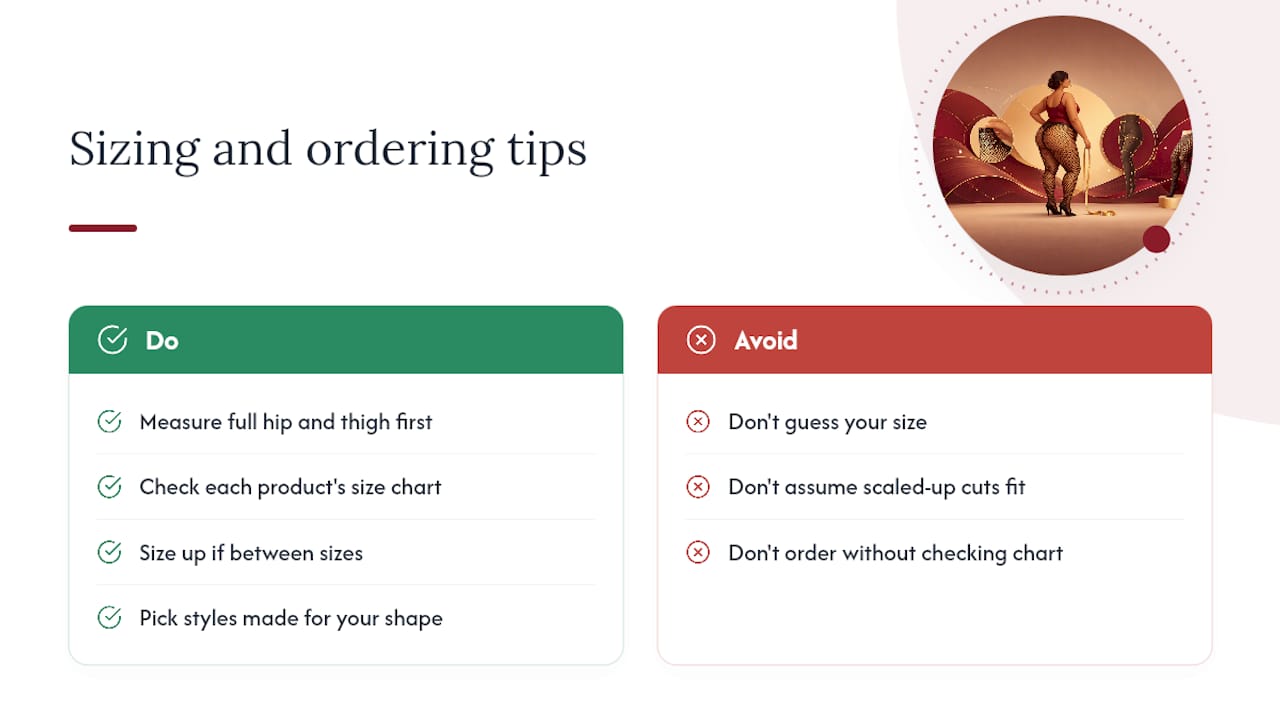
Measure your hips at their widest point, then check that number against the brand’s own size chart rather than guessing from your dress size. If your hips or thighs fall between two sizes, size up. Fishnet fabric stretches differently depending on how it’s knitted, and inclusive plus-size ranges exist precisely because “one size fits all” rarely does. A range built with this in mind is available, featuring clear sizing notes on every product page.
TL;DR:
- Measure hips and thigh circumference accurately before choosing a size, as these are critical for ensuring a proper fit.
- Use the brand’s specific size chart format, such as height-and-weight, dress size, or stretch limit, rather than relying on generic clothing sizes.
- Size up when in doubt or if measurements fall between two sizes to prevent fabric strain, sagging, or splitting during wear.
- Check elastane or spandex percentage and stretch limits to assess how well the stockings will fit your body shape.
- Prioritize actual measurements over labels, especially for plus-size and athletic builds, to avoid ill-fitting stockings and premature damage.
Table of Contents
- How to measure yourself for fishnet stockings size
- How to read size charts and convert sizes for fishnet stockings
- Fit guidance for different body types, including plus size and curvy shapes
- How fishnet construction and stretch affect sizing
- Care, maintenance and how to extend the life of fishnet stockings
- Why measurements matter more than the label ever will
- Playhause picks: recommended fishnet stockings and sizing help
- Sources
- FAQ
How to measure yourself for fishnet stockings size
Getting a reliable fishnet stockings size starts with numbers, not guesswork. Weight-based charts are a rough guide at best. Two people can weigh the same and carry it completely differently through the hips and thighs, and that’s exactly where fishnet lives or dies on fit. A tape measure gives you something a bathroom scale never will: the actual shape the fabric has to stretch around.
Here’s how to do it properly, on your own or with a friend holding the tape steady:
- Hips. Stand with your feet together and wrap the tape around the widest part of your hips and bottom, usually a few inches below your natural waist. Keep the tape level all the way round, not sagging at the back.
- Waist. Measure at your natural crease, the narrowest point above your belly button, breathing normally rather than pulling in.
- Thigh circumference. Measure the fullest part of one thigh, roughly an inch below the crotch. This is the single most important number for hold-ups.
- Height. Stand against a wall without shoes and measure straight up. Height bands matter more for full tights than for thigh-highs.
- Inseam or torso length. For full bodystockings or footed tights, measure from your natural waist down the inside of your leg to the ankle.
A few practical habits make these numbers repeatable. Wear the underwear you’d actually wear with the stockings, since a thick seam or high-waisted brief changes the reading. Keep the tape snug but not tight enough to dent your skin, and measure standing rather than sitting. Write the figures down. A retailer’s size chart is only as useful as the accuracy of what you’re matching it against, and this is where measuring hips and thigh circumference gives the most reliable fit signal for fishnets, more so than height or weight alone.
Different styles lean on different numbers. Full fishnet tights depend most on hip and waist measurements, since the fabric has to stretch across your whole lower body without sagging or bunching. Hold-ups and thigh-highs live or die on thigh circumference and where the elastic band sits, so that’s the figure to prioritise if you’re buying separates rather than a full pair.
How to read size charts and convert sizes for fishnet stockings
Once you have your numbers, the next hurdle is decoding what the brand is actually asking for. Fishnet stocking size charts tend to fall into three formats, and knowing which one you’re looking at saves a lot of second-guessing.
The first is the height-and-weight table, common on mainstream hosiery pages. Memoi’s own chart, for example, maps sizes from Small through to X Large against height and weight bands, with X Large covering roughly 5’2" to 6’0" and 170 to 225 lb. It’s a quick reference, but weight alone tells you nothing about where that weight sits.
The second is the lettered or dress-size table, which some plus-size specialists use instead of vague small/medium/large labels. Snag Tights runs a dual-path system that separates “curvilicious” and “athletic” builds, mapping US clothing sizes and height bands to lettered sizes running from A right through to G, covering sizes 0 to 32. This approach recognises that two people wearing the same dress size can need different hosiery sizes depending on where their curves sit.
The third is the stated stretch limit, seen on many plus-size-specific products, which tells you the maximum dimension the garment will physically reach rather than a recommended range. Sock Dreams lists its plus-size spandex fishnet as stretching to roughly 55 inches at the waist and 60 inches at the hips, which is genuinely a useful number because it’s a hard ceiling, not a marketing suggestion.
A few rules of thumb apply across all three formats:
- If your hip and waist measurements suggest different sizes, go with the size that fits your hips for anything covering the full leg.
- For hold-ups, thigh circumference outranks every other number.
- When you’re between two sizes on any chart, size up rather than down. Fishnet that’s slightly loose still looks intentional; fishnet stretched past its limit runs or splits.
| Chart type | Example brand | What it tells you | Best used for |
|---|---|---|---|
| Height and weight | Memoi | Broad size band by build | Quick first check |
| Lettered / dress size with fit path | Snag Tights | Curvy vs athletic shape matching | Readers with pronounced hip to waist difference |
| Stated stretch limit | Sock Dreams | Maximum garment dimension | Plus-size buyers checking a hard ceiling |
“One size fits all” isn’t always a hollow claim. On garments knitted with a high proportion of elastane, the fabric genuinely has enough give to suit a wide range of bodies comfortably. On a looser, more traditional nylon fishnet, the same label usually means “fits a narrower range than advertised,” and that’s where checking the actual stretch figures pays off.
Fit guidance for different body types, including plus size and curvy shapes
A correct fishnet stocking size isn’t just a number, it’s a number matched to your particular shape. The same size label can behave completely differently depending on where you carry your curves, your height, or how toned your legs are.
Fuller hips and thighs. Look specifically for plus-size labelling rather than assuming the largest standard size will stretch far enough. Reinforced seams and a visibly stretchier knit are good signs the brand has actually engineered for this body type rather than just printing a bigger number on the same fabric. If you’re torn between two sizes, size up every time. A slightly roomier fishnet still looks good; one that’s straining at the diamonds will ladder within a single wear.
Taller bodies. Check the height band on the chart as carefully as the weight or dress size, and look for long or tall variants where they exist. The risk for taller wearers isn’t usually width, it’s length. If the stocking is too short for your leg, the diamond pattern stretches into narrow, distorted ovals right at the crotch and upper thigh, which looks obviously wrong and puts extra strain on the fabric exactly where it’s least reinforced.
Athletic or smaller builds. A fishnet designed for an average or fuller leg can look loose and baggy on slimmer thighs, with the diamond pattern hanging rather than sitting flat. Some brands scale their diamond gauge down for smaller sizes specifically to avoid this. It’s worth checking product photos on a model closer to your build before assuming a small size will automatically look neat.
When your measurements don’t agree with each other, prioritise hips over waist for any style covering the leg. A stocking that’s slightly loose at the waist is invisible under clothing; one that’s tight across the hips will show, sag, and run far faster.
Pro Tip: Do a five-minute test before you wear stockings out. Put them on, sit down, stand up, and walk a few steps. If the waistband rolls, the crotch sags, or the diamonds visibly stretch into ovals rather than staying diamond-shaped, you’re in the wrong size, even if the tag says otherwise.
Watch for these warning signs when you first try a new size:
- Waistband rolling or digging in within minutes of wearing.
- Visible sagging at the ankle or knee that doesn’t correct with a small adjustment.
- Diamonds stretched into long ovals rather than even shapes.
- A tight, shiny sheen across the thigh, which usually means the fabric is close to its stretch limit.
How fishnet construction and stretch affect sizing
Two stockings labelled the same size can fit completely differently, and the reason usually comes down to how the fishnet itself is built, not the number on the packet.
Knit tightness changes how the whole garment behaves under tension. A tight, dense knit holds its diamond shape well and resists laddering, but it has less give, so it needs a more accurate size match. A looser, more open knit stretches further and suits a wider range of bodies, though it trades away some of that durability. Sock Dreams notes exactly this trade-off on its plus-size range, where a looser knit allows greater stretch but is inherently less sturdy than a tighter weave.
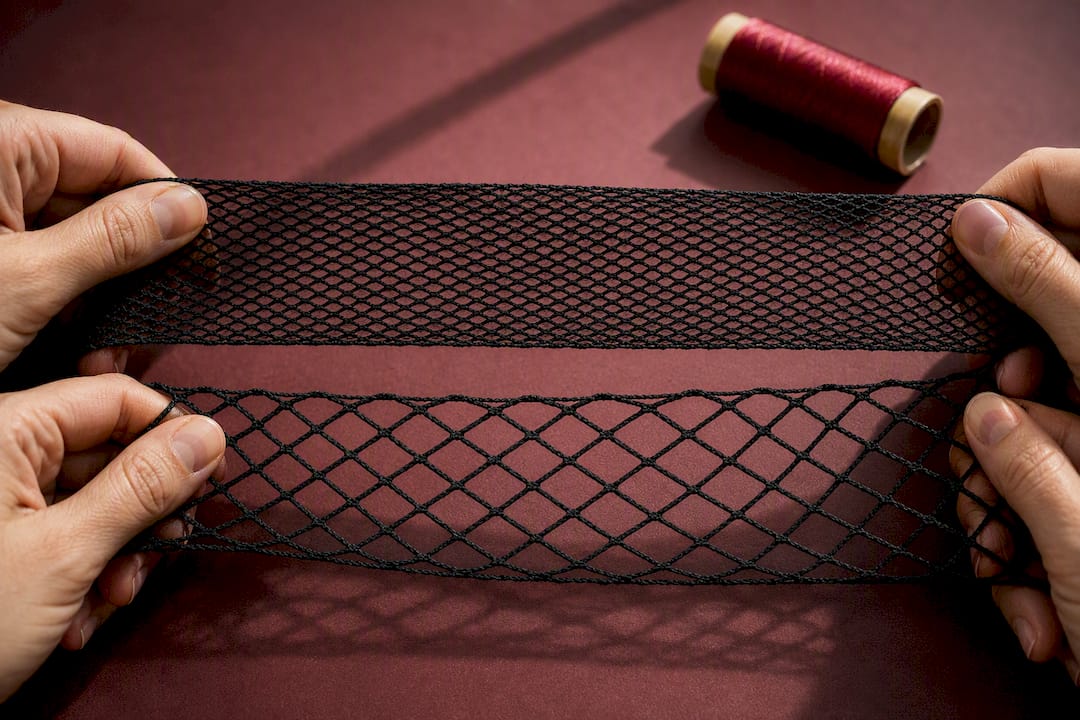
Elastane or spandex content is the number worth checking in a product description if you can find it. Higher elastane content means the fabric recovers its shape after stretching, which is exactly why some high-elastane “one size” fishnets genuinely do work across a broad range of bodies, while a low-elastane nylon fishnet marked one size usually doesn’t.
Denier, the measurement so central to sizing sheer tights and standard hosiery, is far less useful here. Fishnet’s open structure means the yarn thickness barely affects how the garment fits, though it still affects how opaque and durable the mesh looks.
Look for these signals in a product listing before you buy:
- A stated elastane or spandex percentage, not just “stretch fabric.”
- An explicit stretch limit in inches, rather than just a size label.
- Language distinguishing a fitted knit from a loose or fishnet-plus construction.
Care, maintenance and how to extend the life of fishnet stockings
Even a correctly sized fishnet stocking won’t last if it’s washed or worn carelessly. A handful of habits make a genuine difference to how long the fit and the fabric hold up.
- Wash cold and gently. Hand-wash in cold water with a mild detergent, or use a mesh delicates bag on your machine’s coldest, gentlest cycle.
- Skip the tumble dryer entirely. Heat is the fastest way to kill elastane recovery. Lay the stockings flat to air-dry instead.
- Check your accessories before wearing. Remove rough rings or bracelets that can snag the mesh, and smooth any rough edges inside shoes, which is a common, avoidable cause of runs at the ankle.
- Manage small runs immediately. A tiny snag can often be dabbed with clear nail varnish to stop it spreading; a larger tear usually means it’s time to replace rather than repair.
- Retire stockings once the stretch stops recovering. If the fabric stays visibly loose or the diamonds no longer sit flat after washing, the fit is permanently gone, no matter how careful you are with it going forward.
Why measurements matter more than the label ever will
The conventional advice on fishnet sizing leans far too heavily on weight charts and vague small/medium/large labels, and that’s backwards. Weight tells you almost nothing about where your body carries its curves, and that’s precisely the detail fishnet is least forgiving about. Two people at the same weight can need genuinely different sizes.
What the evidence actually supports is a hierarchy: measure hips and thighs first, check the brand’s own chart format second, and treat weight or dress size as a distant third. Brands that offer separate fit paths for curvier and more athletic builds, rather than a single generic scale, tend to get readers into the right size faster because they’re acknowledging that shape matters as much as overall size.
If you take one thing from this, take this: stop trusting the label and start trusting the tape measure. Size up when in doubt, and treat a stated stretch limit as a hard ceiling rather than an aspiration.
— Will
Playhause picks: recommended fishnet stockings and sizing help
The range spans classic full fishnet stockings through to plus-size hold-ups, with clear product-level sizing notes so you’re matching your actual measurements rather than hoping for the best, and orders ship in discreet packaging.

If you’ve measured full hip and thigh and want a reliable everyday fishnet, the Beauty Night BN6542 Romance Stockings in black is a solid, classic option. For fuller hips and thighs specifically, the Ballerina 593 plus-size hold-ups and the Ballerina 595 plus-size hold-ups are built with a stretchier knit designed for that shape, rather than simply scaling up a standard cut. Prefer a classic thigh-high with a bit of colour? The Ballerina 572 Black/Emerald Stockings is worth a look.
Every product page carries its own size chart, so measure first using the steps above, then check that figure against the listing before you order. If you land between two sizes, sizing up is almost always the safer call. Should the fit still be off once it arrives, a returns and exchange process means getting the right size isn’t a dead end. Take your measurements, pick the style that matches your shape, and order with confidence.
Sources
Sizing guidance in this article draws on real retailer charts: Memoi’s height and weight table, Snag Tights’ curvy versus athletic size guide, Sock Dreams’ plus-size stretch specifications, and general apparel guidance on fishnet construction and fit.
- Memoi women’s maxi black nylon fishnet stockings black xl — Target
FAQ
What are the different sizes of fishnet tights?
Fishnet tights are typically sized using height and weight bands (Small to X Large), lettered sizes tied to dress size and height, or a stated maximum stretch limit for plus-size styles. The format varies by brand, so always check which system a specific product uses before ordering.
How do you know what size stockings to get?
Measure your hips at their widest point and your thigh circumference, then match those numbers to the brand’s chart rather than relying on your usual clothing size. When your measurements fall between two sizes, size up rather than down.
How do I determine my pantyhose size?
Use the same hip, waist, and height measurements you’d take for fishnet stockings, since most pantyhose charts use the same height-and-weight or dress-size format. Weight alone is a weak indicator, so always measure rather than estimate.
Why do fishnet stockings feel tighter than my usual size suggests?
Fishnet has less give in the direction of the knit than smooth hosiery, so a size that matches your dress size can still feel snug if the knit is tightly constructed. Checking the stated elastane content or stretch limit before buying helps avoid this mismatch.