


Collar etiquette comes down to one governing rule: respect the negotiated meaning behind the collar, and never override the consent that put it there. Everything else, from who can touch it to how it’s worn in public, follows from that single principle. This guide walks through what a collar signifies, the rules the community has built around it, and how to handle the practical and emotional sides of wearing, granting, or ending a collaring arrangement.
TL;DR:
- Collars symbolize different relationship aspects, such as commitment, ownership, protection, and identity, with meaning always rooted in prior negotiation.
- Choosing the appropriate collar type depends on context, with options including day, play, training, formal, or permanent, each serving different purposes.
- Collar etiquette emphasizes respecting boundaries, avoiding unpermitted contact, and understanding the collar’s significance based on the specific relationship and situation.
- Proper collar safety involves correct sizing, material choice, and planning for emergency removal, alongside emotional aftercare post-ceremony or scene.
- Discreet public collar wear relies on subtle jewelry that can pass as ordinary accessories, with the understanding that a collar’s meaning is determined through mutual negotiation.
Table of Contents
- What does a collar mean in a D/s dynamic?
- Types of collars and when people choose them
- What are the rules of collar etiquette?
- How does a collaring ceremony work?
- How do you keep a collar safe and comfortable?
- How do you wear a collar in public discreetly?
- What happens when a collar relationship ends?
- What a real collaring taught me about courtesy
- A discreet way to complement your collaring journey
- Sources
- FAQ
What does a collar mean in a D/s dynamic?
A collar functions as a relationship token, not unlike a wedding band, and its meaning depends entirely on what the couple or group has agreed it represents. Collars in BDSM typically signal submission or that a person is “spoken for” within a dominant/submissive dynamic, but the specific weight of that signal varies enormously from one relationship to the next.
Four themes tend to recur when people explain what their collar means to them:
- Commitment. A visible or symbolic marker of an ongoing dynamic, often mirroring the emotional register of an engagement or marriage.
- Ownership. Always negotiated, never assumed. Ownership in this context describes a consensual power exchange, agreed in advance, not a claim one partner can impose unilaterally.
- Protection. Some wearers describe the collar as a signal to others in a scene or community that they are accountable to someone, which can discourage unwanted attention.
- Identity. For many submissives, the collar is a private anchor. It reminds them who they are within the dynamic, separate from how others read it.
The same object can carry wildly different meanings depending on context. A collar worn during a single scene might mean nothing beyond that hour. The same style of collar, given after months of negotiation and worn daily, might represent a formal, ongoing commitment. Community pages on BDSM practice consistently point back to the same idea: meaning lives in the negotiation, not the hardware. A leather strap bought from a market stall can carry more weight than an expensive metal piece, if that’s what the couple agreed.
Types of collars and when people choose them
Not every collar is meant to be worn forever, and not every collar is meant to be seen. Recognising the type in front of you (or choosing the right one for yourself) is a big part of getting etiquette right.
- Day collars. Discreet, “vanilla-passing” jewellery, such as a fine chain or pendant, worn continuously without drawing outside attention. Recognisable to those who know, invisible to those who don’t.
- Play collars. Worn only during a scene, often leather or fabric, removed once the session ends. These carry no ongoing relationship claim unless the couple says otherwise.
- Training collars. Given during an evaluation or probationary period, often before a deeper commitment is confirmed. They signal “in progress,” not “finished.”
- Formal collars. Presented during a ceremony, often heavier or more symbolic in design, marking a defined commitment with agreed terms.
- Permanent collars. Intended for long-term or lifetime wear, sometimes with a locking mechanism, reserved for well-established dynamics with clear removal protocols already in place.
- Non-physical alternatives. A ring, a specific necklace, or even a private verbal phrase used only between partners. Not everyone wants or can wear a physical collar, and the symbolism transfers just fine.
Material and visibility create real trade-offs. Leather and metal look striking but rarely pass as everyday jewellery. A slim chain or ring solves the discretion problem but sacrifices some of the visual weight that makes a formal collar feel significant during a ceremony. Choosing the right type is really choosing how loudly you want the dynamic to speak.
What are the rules of collar etiquette?
Most collar etiquette breaks down into a short list of behaviours that protect the wearer and the relationship behind the collar. None of this is enforced by any central authority. As one community guide on collar etiquette “commandments” puts it, there’s no single rulebook across the kink community. What matters is whether the practice works for the people involved and holds up to consent.
That said, a handful of norms show up consistently enough to treat as defaults:
- Never touch someone’s collar without permission. This is close to universal. A collar is treated as an object of deep personal significance, and reaching for one uninvited is roughly the social equivalent of grabbing someone’s hand without asking.
- Don’t flirt with, or attempt to “collar-shop,” someone who is already collared. A worn collar is a signal, and ignoring it because you find someone attractive is a breach of basic courtesy, not a grey area.
- Address collared submissives the way their Dominant prefers, if that preference is known. Some Dominants set specific honorifics or forms of address for their submissive in public settings; others don’t bother. If you don’t know, default to the person’s own name and let them correct you.
- Ask before assuming speaking permissions. Some dynamics involve protocols where a submissive defers to their Dominant before answering certain questions in a social setting. If you notice this happening, don’t push the submissive to “just answer” you directly.
- Recognise the difference between a training collar and a permanent one, and adjust your behaviour accordingly. A training collar suggests things are still being worked out. A permanent collar suggests they’re settled. Treat the second with more formality than the first.
- Don’t ask intrusive questions about a collar’s meaning in front of others. If you’re curious, ask privately, and accept a polite “we’d rather not say” as a complete answer.
- If you’re new to a scene or event, watch before you engage. Observing how established members interact with collared people for ten minutes will teach you more than any list of rules.
A short script helps when you’re unsure how to greet someone new to you at an event: “Lovely to meet you. Am I right to speak with you directly, or is there someone I should check with first?” It’s a small courtesy that signals you understand the dynamic might involve protocols you can’t see.
Pro Tip: If etiquette in a specific situation feels unclear, default to asking the Dominant, not guessing. A quiet “is it alright if I greet your submissive directly?” costs you nothing and prevents an awkward misstep.
How does a collaring ceremony work?
A collaring ceremony formalises what was previously private, turning a negotiated understanding into something witnessed, spoken, and (often) documented. Typical collaring guides describe ceremonies built around three elements: negotiation beforehand, a symbolic presentation of the collar itself, and agreed protocols for what happens afterwards.
Before any ceremony, most couples work through a negotiation checklist covering the ground rules:
- Scope of consent. What does the collar mean, specifically, for this relationship? Ownership, exclusivity, a title, or simply a public marker of commitment?
- Wear schedule. Is the collar worn constantly, only at home, only during scenes, or only at events?
- Safety limits. What activities, if any, does wearing the collar imply consent for, and what remains separately negotiated?
- Removal rules. Who can remove the collar, under what circumstances, and what does removal mean for the relationship?
The ceremony itself often includes witnesses (sometimes just the couple, sometimes close friends or community members), a short verbal exchange or vow, and the physical act of placing the collar. The ritual matters because it gives both partners a shared memory to return to when the relationship needs recalibrating.
Documentation doesn’t need to be elaborate. A written checklist covering the points above, kept somewhere both partners can access, works fine for most people. Some couples go further and draft a more detailed agreement, alongside an emergency contact plan in case the collar ever needs removing outside the relationship’s normal process.
How do you keep a collar safe and comfortable?
Fit matters more than most newcomers expect. A collar that’s too tight risks restricting breathing or circulation during long wear; one that’s too loose can catch, snag, or slip in ways that are more annoying than dangerous but still worth avoiding. A simple fit test many people use: you should be able to slide two fingers comfortably between the collar and your neck. If you can’t, it’s too tight.

Material choice affects both comfort and safety. Skin-safe metals such as surgical steel or solid sterling silver reduce the risk of irritation for daily wear. Tight-fitting plastic or resin pieces, by contrast, don’t flex with the body and can become uncomfortable or even painful over a full day.
Emergency access deserves its own line of thinking, separate from day-to-day comfort:
- Avoid permanent seals without a key or release mechanism, however romantic a “locked forever” design sounds. If a collar can’t come off quickly in an emergency, it’s a liability, not a symbol.
- Agree an access plan in advance. Both partners should know exactly how the collar comes off if one of them is unable to remove it themselves.
- Keep a spare key or tool somewhere accessible, not just in the Dominant’s possession, if the collar locks.
Aftercare deserves the same seriousness after a collaring ceremony as after any intense scene. Proper aftercare involves checking in emotionally in the hours and days following the ceremony, not just confirming the collar fits. Drop, the emotional low that can follow an intense or meaningful experience, is a genuine and well-documented phenomenon in kink communities, and a new collaring is exactly the kind of event that can trigger it. Building a check-in routine, even a simple daily text for the first week, catches problems before they become serious.
How do you wear a collar in public discreetly?
Wearing a collar outside a private setting means balancing two things that often pull against each other: wanting the dynamic to feel real and visible, and needing to move through work, family, and public life without unwanted conversations. Day collars solve most of this problem by design.
A well-chosen day collar reads as ordinary jewellery to anyone who isn’t looking for it, while still signalling the dynamic to people who recognise the style. Practical choices that work well for daily wear include:
- A fine chain necklace, sometimes with a small, unobtrusive pendant that has private significance.
- A simple metal band or ring, worn on a finger that doesn’t draw attention.
- A slim choker in a neutral colour, chosen specifically because it looks like fashion rather than fetishwear.
Workplace and family settings usually call for the most conservative option in your wardrobe. If someone does ask about it, a light, deflecting answer works better than an elaborate explanation: “It’s just a necklace I like” is complete, true, and closes the conversation without lying about anything that matters. Reading the room matters here. A collar that’s perfectly fine at a partner’s family dinner might need to come off before a formal work event, and having that conversation with your Dominant in advance avoids an awkward decision made under pressure.
What happens when a collar relationship ends?
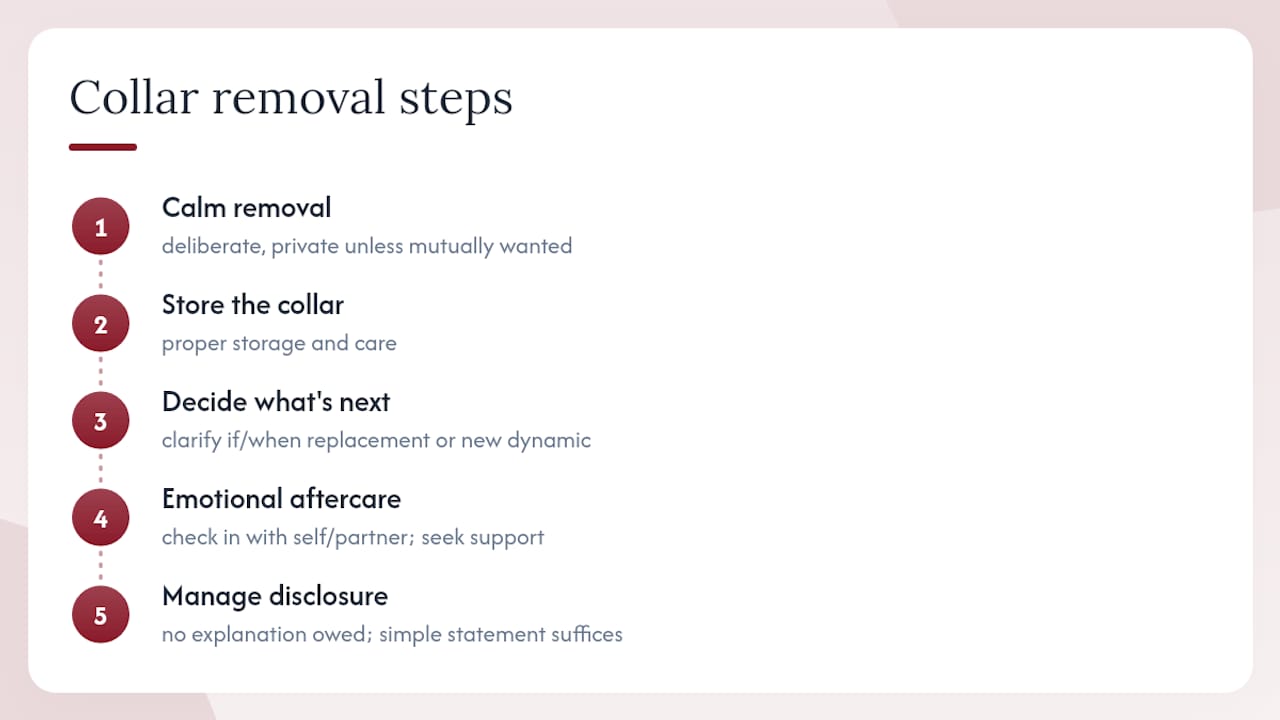
Removing a collar, whether by mutual agreement or because the relationship is ending, calls for the same care as putting one on. Practically, that means a calm, deliberate removal (not a dramatic or public one, unless that’s specifically wanted), proper storage of the collar itself, and a clear sense of whether or when a replacement or new dynamic might follow.
Emotionally, this moment can hit harder than people expect, even when the ending is mutual and healthy. Treat it as its own aftercare event: check in with yourself and, where appropriate, with your former partner, and don’t be afraid to lean on community friends or a counsellor if the loss feels heavier than anticipated.
Socially, you don’t owe anyone an explanation. “We’re not collared anymore” is a complete sentence. Some people prefer silence until they’re ready to talk, and that’s a legitimate choice too.
What a real collaring taught me about courtesy
A friend described her collaring ceremony to me once: small gathering, a handful of trusted witnesses, a short spoken agreement about what the collar would and wouldn’t mean day to day. Weeks later, at a munch, a well-meaning stranger reached to touch the collar out of curiosity. Her Dominant stepped in calmly, not sharply, and simply said, “That’s hers to offer, not yours to take.” No drama, no lecture, just a clear boundary held without embarrassment.
That’s the whole of collar etiquette in one moment. The rules aren’t complicated. They just require the same respect you’d extend to any negotiated agreement between adults.
— Will
A discreet way to complement your collaring journey
A retailer won’t tell you what your collar should mean; that’s between you, your partner, and whatever you’ve negotiated. What it can offer is a practical bridge between the symbolic and the everyday: jewellery-style pieces that pass as ordinary accessories for day-collar wear, and aftercare essentials for the vulnerable hours after a ceremony or scene.

Discretion matters here more than in most shopping categories. Orders ship in plain, unmarked packaging, with free delivery on orders above a certain amount, which matters if you’d rather not explain a delivery van to a housemate. For a formal celebration or a quiet night marking a new commitment, pieces like the Beauty Night BN6731 Lorna Red pair well with the occasion without saying a word about it to anyone who doesn’t already know. Browse the full range and find something that fits the moment, whether that’s a ceremony, an anniversary, or simply a quiet evening you want to mark as yours.
Sources
The Wikipedia entry on collars in BDSM covers core terminology and history. Consensual Dominance’s collar manners guide sets out widely shared community etiquette. Kink Checklist covers public wear and day-collar strategy in more depth.
FAQ
Is it rude to touch someone’s collar?
Yes. Touching a collar without asking first is one of the most consistently cited breaches of etiquette across community guidance, because the collar represents a personal and negotiated relationship, not decorative jewellery available for anyone to handle.
Can I flirt with someone who is wearing a collar?
No. A worn collar signals that someone is already in a dynamic, and flirting or attempting to “collar-shop” a collared person is treated as a clear breach of respect within the community.
What’s the difference between a day collar and a permanent collar?
A day collar is discreet, vanilla-passing jewellery meant for continuous, low-visibility wear, while a permanent collar is a formal, long-term symbol usually tied to an established, well-negotiated dynamic.
How do I know if a collar means ownership or something less formal?
You ask the wearer or their partner directly, privately, and accept whatever answer you get, since meaning is always defined by negotiation between the people involved rather than by any fixed rule.
What should happen immediately after a collaring ceremony?
Aftercare, including an emotional check-in and confirmation the collar fits safely, should follow any ceremony, and Playhause’s aftercare guide covers the practical steps for the hours and days that follow.