


Aftercare is the intentional physical and emotional care partners give each other once a scene ends. If you only remember one thing from this bdsm aftercare guide, make it this: stay present, and check breathing and circulation before anything else. Talking, tidying, and processing can all wait a few minutes.
That first window matters, but so does what comes after. Aftercare works in two phases: an immediate response in the minutes right after play, and a follow-up phase that can stretch across the next few days.
- Check breathing, pulse, and skin colour first
- Offer water and warmth before conversation
- Stay physically present, even if you’re not speaking
- Plan a check-in for the next day and the day after that
Key Takeaways
Effective BDSM aftercare combines an immediate physical safety check, sustained emotional presence, and a structured follow-up schedule across the next 72 hours.
| Point | Details |
|---|---|
| Safety comes first | Check breathing, circulation, and skin colour before anything else, even conversation. |
| Sub drop is chemical | Falling adrenaline, endorphins, and oxytocin cause a genuine comedown, not weakness. |
| Follow a check-in schedule | Text at 2 to 3 hours, then 24, 48, and 72 hours to catch delayed drop early. |
| Negotiate aftercare in advance | Agree on touch, space, and check-in signals before the scene begins, not after. |
| Prepare comfort items ahead | Playhause’s loungewear and hosiery cover the warmth and comfort categories of any aftercare kit. |
Table of Contents
- What is BDSM aftercare and who needs it?
- Why does sub drop happen after intense play?
- What physical aftercare should happen in the first 10 minutes?
- How do you give emotional support in the first hour?
- How long can delayed drop last and how do you check in?
- What should go in an aftercare kit?
- How do you negotiate aftercare before a scene?
- What does self-aftercare and dom drop recovery look like?
- When is aftercare not enough and you need help?
- Evidence behind this guide
- Why preparation changes everything about aftercare
- Playhause aftercare kit essentials for discreet comfort
- Frequently asked questions
- Sources
What is BDSM aftercare and who needs it?
Aftercare, drawn from established BDSM community and encyclopaedic practice, refers to the deliberate steps partners take to support each other’s physical and emotional state once intense play has stopped. It’s not a bonus round reserved for heavy scenes. It’s a standard part of consensual kink, in the same category as negotiation and safe words.
Aftercare applies to everyone in the scene, not just the person who received impact, restraint, or sensory play.
- Submissives often need reassurance, warmth, and grounding after surrendering control
- Dominants can experience their own comedown, sometimes called dom drop, after the adrenaline of directing a scene fades
- Switches may need different care depending on which role they held that session
- Solo players still benefit from self-directed aftercare after intense solo scenes
Immediate aftercare covers the first hour or so. Follow-up aftercare covers the next 24 to 72 hours, when delayed emotional responses tend to surface. Treating both as normal, expected parts of play, rather than something only needed when a scene “goes wrong”, is what separates confident kink practice from guesswork.
Why does sub drop happen after intense play?
Sub drop isn’t a mood swing. It’s a chemical comedown. Intense BDSM play floods the body with adrenaline, endorphins, oxytocin, and dopamine, and when the scene ends, those levels fall quickly. That crash can produce sadness, tearfulness, anxiety, or a hollow, flat feeling, even after a scene both partners genuinely enjoyed.
Peer-reviewed research on postcoital mood changes has documented negative mood states following intense sexual activity in a meaningful minority of people, a pattern researchers link to the same neurochemical shifts seen in sub drop and dom drop.
This overlaps with postcoital dysphoria, a recognised phenomenon where people feel low, weepy, or irritable after sex despite it being consensual and wanted. The mechanism is similar: a sharp rise in arousal-linked chemicals followed by a steep drop. A study on postcoital mood changes found this pattern is well documented in clinical literature, and a broader clinical study on sexual behaviour and mood reinforces that the comedown is physiological, not a sign that something went wrong.
A PMC review on sexual aftercare and emotional regulation concludes that structured aftercare helps regulate this transition rather than leaving it to chance. A notable minority of kink practitioners report experiencing some form of drop, which makes planning for it, rather than reacting to it, the more reliable approach.
What physical aftercare should happen in the first 10 minutes?
Physical safety comes before emotional processing, always. Work through this sequence before anything else:
- Check airway, breathing, and circulation. If rope was used, check hands and feet for numbness, tingling, or colour changes.
- Offer water immediately. Room-temperature water supports the electrolyte balance the CDC recommends after physical exertion.
- Give a small snack with carbohydrate and protein. Oat bars, toast, or fruit with nut butter help stabilise blood sugar after an adrenaline spike.
- Skip alcohol and caffeine for the first hour. Both interfere with the body’s natural recalibration and can worsen shakiness or anxiety.
- Add warmth. A blanket, dressing gown, or your own body heat helps counter the drop in body temperature that often follows intense exertion.
- Check marks and skin. Cold compresses reduce swelling from impact play; arnica gel can help bruising; clean and dress any broken skin.
- Watch for red flags. Fainting, confusion, severe pain, or numbness that doesn’t resolve within a few minutes needs urgent medical attention, not a wait-and-see approach.
If rope was part of the scene, circulation checks aren’t optional; numbness that persists after release is a sign to seek medical advice, not something to monitor overnight.
Pro Tip: Keep a “grab and go” pouch by the bed with water, a snack, and a blanket. Deciding what to grab mid-drop wastes precious minutes when your partner needs you focused, not rummaging through drawers.
How do you give emotional support in the first hour?
Presence matters more than words in the first 10 to 30 minutes. Sit close, hold your partner if they want contact, or simply stay in the room if they need space. Silent presence, with low-stimulation touch such as stroking hair or holding hands, tells the nervous system it’s safe without demanding a response.
Resist the urge to debrief immediately. “How was that for you?” can wait. In the first half-hour, reassurance beats analysis:
- “I’m right here.”
- “You did so well.”
- “There’s no rush, we can talk whenever you’re ready.”
- “Do you want me to stay quiet or talk?”
Save the fuller conversation, what worked, what didn’t, how the safe word felt, for later that day or the next, once both of you are out of the immediate comedown.
Adjust the environment to match what your partner needs. Dim harsh lighting, lower noise, bring over a familiar object like a soft blanket or a favourite drink. Verywell Mind’s guidance on aftercare points out that tailored aftercare, cuddling for some, quiet solitude for others, reduces the risk of lingering negative emotion far more effectively than a one-size-fits-all script.

Pro Tip: Always ask before touching, even mid-aftercare. “Can I hold you?” takes two seconds and respects that consent doesn’t pause once the scene ends.
How long can delayed drop last and how do you check in?
Delayed drop doesn’t always show up straight away. It can surface hours later as irritability, tearfulness, fatigue, or a sudden low mood that seems to come from nowhere, and it commonly lasts across the following few days.
A structured check-in schedule catches this before it spirals:
- Within 2 to 3 hours: a simple text. “How are you feeling now that some time’s passed?”
- At 24 hours: a slightly deeper check. “Any lingering feelings from yesterday? Good or bad, I want to know.”
- At 48 hours: watch for patterns. “Still feeling steady, or has anything shifted?”
- At 72 hours: close the loop. “How’s your week looking? Anything still sitting with you from the scene?”
Community safety resources consistently recommend this 24, 48, 72-hour cadence because delayed drop often peaks a full day after play, well past when either partner expects it. If the same low mood or anxiety reappears after several unrelated scenes, that’s a pattern worth discussing with a kink-aware therapist rather than managing alone each time.
What should go in an aftercare kit?
A prepared kit removes decision-making from the equation exactly when neither of you has the energy for it. Practitioner safety guides consistently group kit contents into four categories.
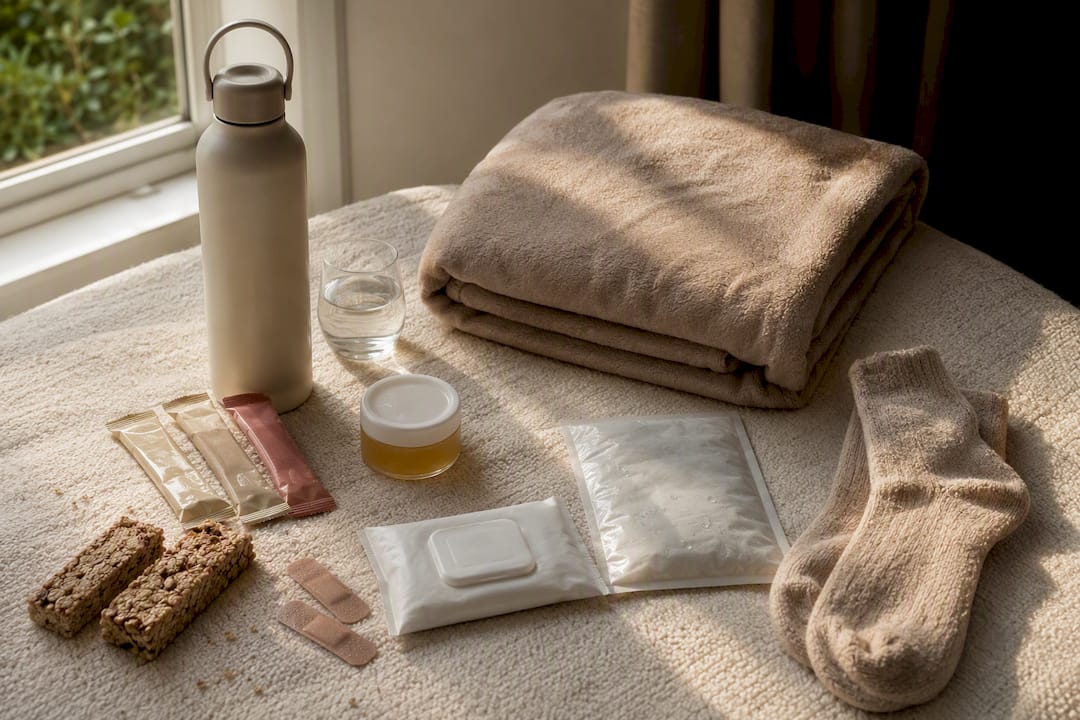
| Category | What to include |
|---|---|
| Hydration and nutrition | Bottled water, electrolyte sachets, oat bars or snacks |
| Skin and wound care | Arnica gel, plasters, antiseptic wipes, cold pack |
| Comfort and warmth | Soft blanket, dressing gown, comfortable hosiery or loungewear |
| Emotional grounding | Favourite playlist, a weighted blanket, a partner’s written note |
Scene-specific additions matter too. Impact play calls for extra cold compresses and arnica. Rope scenes need bandage scissors within reach in case of emergency release. Wax play needs oil or a scraper for cleanup, kept separate from anything sharp.
Store the kit somewhere accessible, a bedside drawer or a labelled box near the play space, so nobody has to search for it mid-drop.
How do you negotiate aftercare before a scene?
Aftercare works best when it’s negotiated with the same care as safe words, not improvised afterwards. Before you begin, cover:
- Touch or space? Ask directly whether your partner wants physical contact immediately after, or prefers a few minutes alone first.
- What’s the check-in signal? Agree on a word or gesture that means “I need aftercare now” versus “I’m fine, give me a minute.”
- How and when should follow-up happen? Text, call, or in person, and at what intervals over the next few days.
- What’s off-limits during aftercare? Some people don’t want a debrief the same night; others want it immediately.
Jot preferences down, even shorthand in a notes app, especially if needs differ between partners. If one person needs more aftercare than the other, that’s not a mismatch to fix. It’s information to plan around. Revisit and update the agreement after every debrief, since preferences shift with experience. This is worth building into the same conversation where you set limits and safe words.
What does self-aftercare and dom drop recovery look like?
Not every scene ends with a partner available to help, and dominants need aftercare too, even though they’re rarely the ones people ask.
- Drink water and eat something with protein, exactly as you would for a partner
- Wrap up in something warm and do something low-stimulation: a familiar show, a bath, quiet music
- Text a trusted friend or play partner beforehand so someone knows to check in
- Journal briefly, even three lines, to externalise what you’re feeling rather than letting it loop
Dominants experiencing dom drop often feel guilt, emptiness, or exhaustion rather than sadness. Active recovery, a short walk, tidying the space, calling a peer, tends to help more than sitting still with the feeling.
Pro Tip: Keep one script ready for hard moments: “I’m having a drop, can you check in with me tonight?” Sending it takes ten seconds and removes the pressure of explaining everything in the moment.
When is aftercare not enough and you need help?
Some situations need more than a blanket and reassurance.
- Deep burns, heavy or uncontrolled bleeding, or signs of shock (pale, clammy skin, rapid pulse, confusion) need urgent medical care
- Numbness or loss of colour in hands or feet that doesn’t resolve within minutes of rope removal
- Persistent low mood, panic, or flashbacks that last days rather than hours, which can indicate trauma needing kink-aware therapy
- A pattern of drop after most scenes, rather than occasional dips, which is worth raising with a professional
The Kink Aware Professionals directory) and similar listings connect people with therapists experienced in BDSM dynamics, which matters because a therapist unfamiliar with kink can misread consensual practice as harm.
Evidence behind this guide
This guide draws on peer-reviewed research into postcoital mood changes, a PMC clinical review of sexual aftercare, and public-health hydration guidance, alongside Playhause’s ongoing coverage of practical kink safety, including guides on bondage, impact play, and beginner-friendly negotiation.
Structured aftercare, built around a prepared kit and a short physical checklist, consistently reduces the cognitive load partners face during a comedown, according to the PMC review’s synthesis of post-intimacy care research.
Use this guide alongside, not instead of, professional care. If red flags from the section above apply to you or a partner, a kink-aware therapist or GP should be your next call.
Why preparation changes everything about aftercare
The biggest misconception about aftercare is that it’s something you improvise once you see your partner needs it. By then you’re already behind. The couples who handle drop well aren’t more emotionally skilled, they’ve just made the decisions in advance: what’s in the kit, who checks in when, what “I need space” sounds like.
Treating aftercare as bilateral, something dominants need as much as submissives, is the shift most guides skip. Build the kit before you need it. Negotiate the check-in schedule before the scene, not after.
Playhause aftercare kit essentials for discreet comfort
A prepared kit is only as good as what’s in it, and Playhause stocks the comfort side of aftercare directly: soft loungewear, comfortable hosiery, and skin-friendly pieces that turn “get warm and stay still” into something that actually feels good.

Map your kit categories to real products. For warmth and comfort, something like the Beauty Night Lorna nightwear works well thrown on straight after a scene, soft against sensitive skin and easy to move in if you need to shift position or get up for water. For the comfort layer under a blanket, soft hosiery adds warmth without restriction. Every order ships in discreet packaging, and delivery is free over £60, so restocking your kit doesn’t mean an awkward parcel on the doorstep. Browse the full Playhause range and build your kit before your next scene, not during the comedown.
Frequently asked questions
What is the immediate priority in BDSM aftercare? Check breathing, circulation, and skin condition first. Everything else, including conversation, can wait a few minutes.
What does sub drop feel like? Sadness, tearfulness, anxiety, or a flat, empty mood caused by falling adrenaline and endorphin levels after intense play.
How long does aftercare typically last? Immediate aftercare covers the first 30 to 120 minutes; follow-up check-ins should continue over the next 24 to 72 hours.
Do dominants need aftercare too? Yes. Dom drop is real and often involves guilt or exhaustion rather than sadness, and it deserves the same structured care.
What goes in a basic aftercare kit? Water, a snack, a blanket, skin care items like arnica or plasters, and something emotionally grounding such as a favourite object or playlist.
Sources
Key sources: the PMC aftercare review, CDC hydration guidance, and kink-aware therapist directories for professional support.
- PubMed: study on postcoital mood changes
- PMC review on sexual aftercare and emotional regulation
- Verywell Mind: Why sexual aftercare is so important